All figures sourced directly from U.S. federal agencies, the UN Office on Drugs and Crime, INTERPOL, and the Canadian Anti-Fraud Centre. No figure in this report is taken from secondary analysis or company self-reporting alone.
Editorial Note and Legal Disclosure
This article is produced for public information purposes only. It reports on matters of documented public record -- court filings, federal agency reports, intergovernmental organization publications, and official law enforcement press releases. Nothing here constitutes legal advice, financial advice, or professional guidance of any kind.
Where criminal charges, civil complaints, or regulatory actions are described, those are allegations. Every named defendant is presumed innocent unless a court has found otherwise. Synexmedia.com makes no finding of guilt, no civil determination, and no assertion beyond what the cited public record states. Readers seeking legal counsel should consult a qualified lawyer.
All source documents are publicly available from the issuing agencies. Links to primary sources are listed at the end of this article.
What You Are Reading
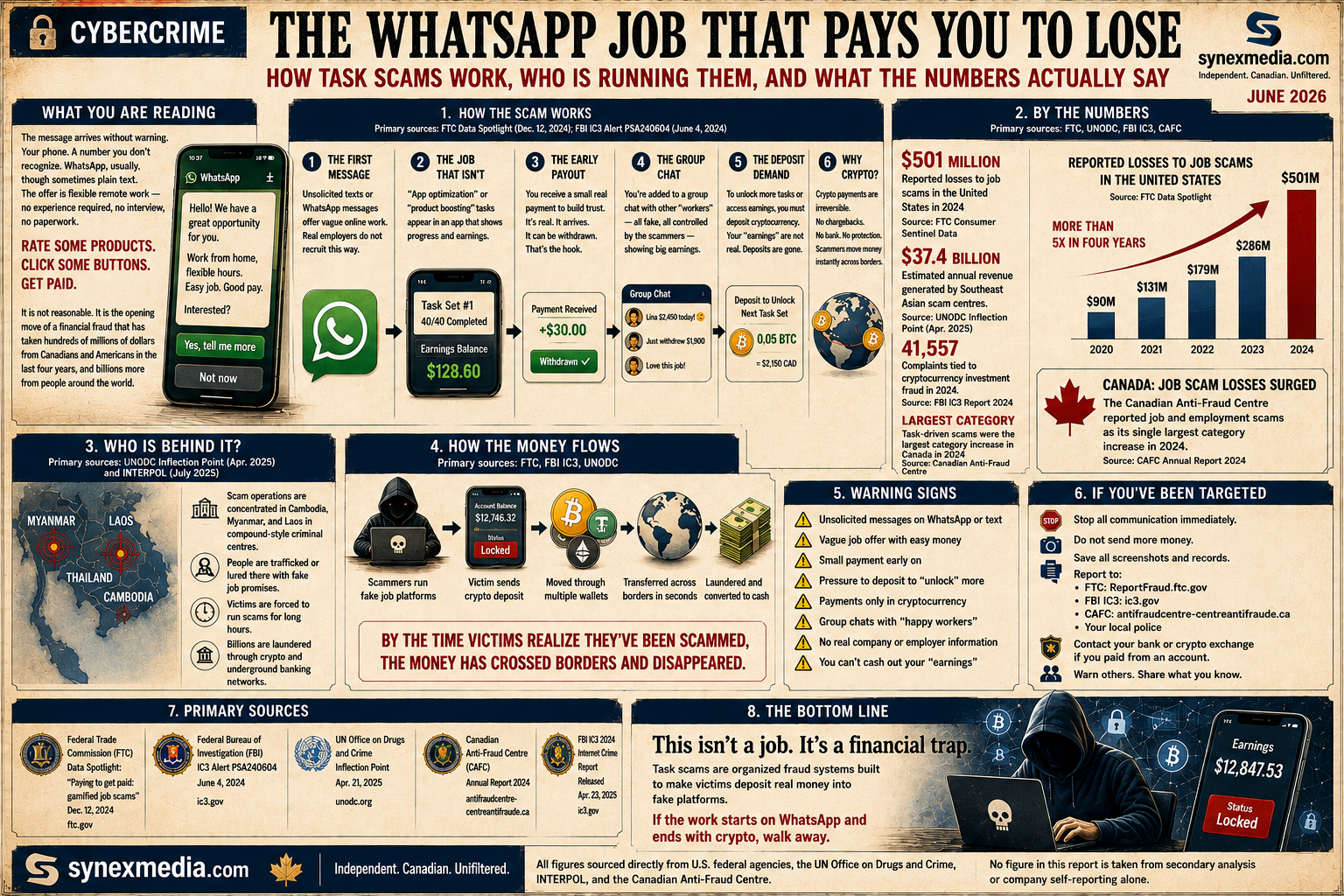
The message arrives without warning. Your phone. A number you don't recognize. WhatsApp, usually, though sometimes plain text. The offer is flexible remote work -- no experience required, no interview, no paperwork. Rate some products. Click some buttons. Get paid. The message is written in plain, unhurried English, and there is something about it that almost sounds reasonable.
It is not reasonable. It is the opening move of a financial fraud that has taken hundreds of millions of dollars from Canadians and Americans in the last four years, and billions more from people around the world. The U.S. Federal Trade Commission calls it a task scam. The FBI calls it crypto investment fraud. Prosecutors in the United States have called it pig butchering. The UN calls the operations behind it an industrial-scale criminal enterprise generating just under forty billion dollars a year.
Every claim in the paragraph above is sourced. Every number comes from a primary government document. This article will show you how the scam works, who is running it, what the documented scale looks like, and what to do if you or someone you know has been targeted. Nothing here is speculation. None of it is reassuring.
1. How the Scam Works
Primary sources: FTC Data Spotlight, December 12, 2024 ("Paying to get paid: gamified job scams drive record losses"); FBI IC3 Alert PSA240604, June 4, 2024.
The Federal Trade Commission's December 2024 Data Spotlight is the most detailed public documentation of how these scams are structured. The FBI's June 2024 public service announcement independently confirms the same mechanics. What follows draws directly from both.
The first message
It comes to a phone number the sender has no legitimate reason to have. No application was submitted. No job board was visited. The message offers online work but gives almost no specifics -- which is the point. The FTC is unambiguous on this: real employers do not recruit through unsolicited texts or WhatsApp messages. The vagueness is not a flaw in the pitch. It is the pitch.
The job that isn't
Once the target responds, a role materializes. The work is described as "app optimization" or "product boosting" -- rating items, clicking likes, completing sets of repetitive digital tasks. An app or platform gets installed. Sets of tasks appear, typically around forty per batch. The platform looks functional. It tracks completions. Numbers accumulate in what appears to be an account balance.
None of it reflects real work or real money. The entire interface is constructed to create an impression of legitimacy. The FTC calls this by name: a gamified job scam. The game aspect is deliberate -- the escalating task sets, the apparent progress, the visible balance. It is designed to feel like work paying off.
The early payout
Here is where the scam earns its hold. Before any deposit is requested, the victim receives a small real payment. The FTC documents this explicitly: scammers pay out a little, in actual money, specifically to gain trust. The payment is real. It arrives. It can be withdrawn. Whatever the amount -- and the FTC confirms it is small -- the psychology of receiving it is significant. The job feels verified. The platform feels legitimate. The next step feels safe.
It is not safe.
The group chat
Hesitation triggers the next tactic. The victim gets added to a group chat. In it, other workers -- all of them fake, all of them controlled by the same operation -- describe their earnings, their progress, their satisfaction. The FTC documented this as a standard component of the scam. The social pressure is manufactured wholesale. Every apparent co-worker is a script.
The deposit demand
To unlock the next task set -- or to access earnings already shown in the account -- the platform requires a deposit. Always in cryptocurrency. The FTC Spotlight is direct: the money shown as earned in the app is not real, and any money deposited will not be returned.
The FBI's June 2024 PSA is equally plain. According to the alert, scammers design the fake job with a payment structure that requires victims to make cryptocurrency payments to earn more money or unlock work, and those payments go directly to the scammer. The platform continues to display earnings. None of those earnings are accessible. The number in the account is theatre.
Why cryptocurrency, specifically
Cryptocurrency transactions are irreversible. There is no equivalent of a credit card chargeback, no dispute mechanism, no bank to call. Once funds are sent to a wallet address controlled by the scammer, they are gone. Cross-border transfer is instantaneous. The receiving wallet can be anywhere on earth. This is not coincidental -- it is why every task scam documented by the FTC and FBI uses cryptocurrency as the payment method. The design choice exists to eliminate recovery.
The escalation loop
The first deposit is rarely the last. A new obstacle appears -- a withdrawal tax, a negative balance, a bonus task requiring top-up, a system glitch that can be resolved for a fee. Each demand is designed to exploit the sunk-cost psychology of someone who has already committed money. Victims who have deposited once are far more likely to deposit again. The FTC and FBI both document this escalation pattern as a core feature of the fraud, not an exception.
The exit
Contact ends. It can happen abruptly or after one final refusal to deposit more. The platform may vanish. The app may stop loading. The scammer, always anonymous, is simply gone. No earnings come out. No deposit is returned. The cryptocurrency is irretrievable.
2. What the Numbers Say
United States: FTC Consumer Sentinel Data
FTC Data Spotlight, December 12, 2024; FTC Consumer Sentinel Network Data Book, March 2025.
Task scam reports filed with the FTC went from zero in 2020 to approximately 5,000 in all of 2023. In the first half of 2024 alone, that figure hit approximately 20,000. By H1 2024, task scams accounted for 38.8 percent of all job scam reports -- up from 5.6 percent the year before.
Reported dollar losses to job scams by year: $90 million in 2020, $131 million in 2021, $179 million in 2022, $286 million in 2023, and $501 million for the full year 2024. Cryptocurrency losses to job scams specifically came in at approximately $21 million for all of 2023, then approximately $41 million in the first half of 2024 alone.
The FTC is clear that task scam figures are estimates built from hand-coding a random sample of reports -- not a full count. And every loss figure represents only what was reported. The FTC states explicitly that reported figures are a fraction of actual losses.
United States: FBI Internet Crime Complaint Center, 2024
FBI IC3 2024 Internet Crime Report, released April 23, 2025.
Total cybercrime losses reported to the IC3 in 2024 reached $16.6 billion -- a 33 percent increase over 2023. Investment fraud was the costliest category for the second consecutive year; the FBI's own press release puts the figure at over $6.5 billion, with the precise IC3 annual report figure at $6.57 billion. Cryptocurrency investment fraud -- which includes pig butchering and task-scam variants -- accounted for $5.8 billion across 41,557 complaints, a 47 percent jump in losses and 29 percent rise in complaints from the prior year. Total cryptocurrency-related losses across all crime types hit $9.3 billion.
United States: 2025 update
IC3 2025 Annual Report, cited in DOJ Scam Center Strike Force press release, April 28, 2026; FBI San Diego field office press release, April 30, 2026.
According to the FBI's IC3 2025 Annual Report -- released in 2026 -- cryptocurrency investment fraud losses rose a further 24 percent in 2025 to over $7.2 billion. The trend has not reversed.
Global: United Nations Office on Drugs and Crime
UNODC, "Inflection Point: Global Implications of Scam Centres, Underground Banking and Illicit Online Marketplaces in Southeast Asia," April 21, 2025.
UNODC estimates that hundreds of industrial-scale scam centres are generating just under US $40 billion in annual profits. The April 2025 report describes a deliberate global expansion by East and Southeast Asian organized crime groups into regions with weaker governance -- Africa, South Asia, the Middle East. The expansion is, in the report's framing, both a growth strategy and a hedge against the disruption being applied to operations in Myanmar, Cambodia, and Laos.
Canada: Canadian Anti-Fraud Centre
CAFC 2024 Annual Statistical Report; CAFC communications cited in Money.ca and Daily Hive, 2025; Government of Canada / Competition Bureau, February 28, 2025.
More than 2,300 Canadians reported losing over $49 million to job and employment scams in 2024. In 2022 the same category totalled approximately $7 million. That is a quadrupling in two years. In the first quarter of 2025 alone, reported Canadian job scam losses reached $22.7 million -- a pace that, if sustained, would exceed the full-year 2024 figure.
The CAFC estimates only 5 to 10 percent of fraud is reported. Total reported Canadian fraud losses across all types in 2024 were $638 million, per federal government figures published in February 2025. The job scam figures sit inside that total. The unreported losses are, by the CAFC's own estimate, roughly ten to twenty times larger.
3. Who Is Running These Operations
UNODC "Inflection Point," April 21, 2025; INTERPOL crime-trend update, July 1, 2025; DOJ press release and indictment, October 14, 2025; FinCEN Section 311 Final Rule, October 15, 2025.
Task scams do not come from lone operators working phones in a spare room. The UN Office on Drugs and Crime and INTERPOL have documented them as the output of industrial-scale criminal infrastructure, built across border zones in Southeast Asia, staffed in substantial part by people who were trafficked there and are being held against their will.
The compound system
UNODC's April 2025 Inflection Point report documents hundreds of industrial-scale scam centres operating primarily in Myanmar, Cambodia, and Laos, supported by underground banking and cryptocurrency-based laundering. The compounds are not improvised. They are purpose-built. They operate in areas where governance is weakest and enforcement is most easily neutralized through corruption or physical remoteness.
INTERPOL's July 2025 crime-trend update placed the human cost in specific terms: as of March 2025, victims from 66 countries had been trafficked into scam centre operations, with 74 percent of those human trafficking victims concentrated in Southeast Asia. The people sending the WhatsApp messages that land on Canadian and American phones may themselves be captives.
Prince Holding Group and Chen Zhi
What follows is drawn entirely from the DOJ indictment unsealed October 14, 2025, in the Eastern District of New York, and from the concurrent DOJ, Treasury, and UK government press releases. These are allegations. Chen Zhi has not been convicted. He is presumed innocent under the law.
The indictment charges Cambodian national Chen Zhi, age 37, founder and chairman of Prince Holding Group, with wire fraud conspiracy and money laundering conspiracy. The allegation is that he directed Prince Group's operation of forced-labour scam compounds across Cambodia. Concurrent with the indictment, the DOJ filed what it described as the largest forfeiture action in its history -- a civil complaint seeking approximately 127,271 bitcoin, valued at approximately $15 billion, already in U.S. government custody.
The U.S. Treasury's OFAC and the UK's Foreign, Commonwealth and Development Office simultaneously sanctioned 146 Prince Group-linked targets. Treasury designated Prince Group a transnational criminal organization. Chen Zhi was arrested by Cambodian authorities in January 2026 and transferred to China, according to reporting from multiple outlets. He had not appeared in U.S. custody as of that date. His lawyers have publicly disputed the forfeiture action, noting the bitcoin had been dormant since December 2020, a fact confirmed in analysis cited in the forfeiture complaint itself.
Synexmedia.com reports these matters as they appear in public court and government records. No finding is made here beyond what those records state.
Huione Group
On October 15, 2025 -- one day after the Prince Group indictment -- the U.S. Treasury's Financial Crimes Enforcement Network issued a final rule under Section 311 of the USA PATRIOT Act severing Huione Group from the U.S. financial system. FinCEN's finding, documented in the rule, was that Huione Group had laundered at least $4 billion between August 2021 and January 2025, including proceeds from cryptocurrency investment scams. The Cambodian government revoked Huione Pay's operating licence in March 2025.
4. What Law Enforcement Has Done
FBI public warning (June 2024)
FBI Internet Crime Complaint Center Alert PSA240604 was issued June 4, 2024. It is the foundational federal public warning on task scams and crypto work-from-home fraud, and remains active guidance.
Operation Level Up
FBI IC3 2024 Annual Report.
Launched in January 2024, Operation Level Up identified 4,323 victims of cryptocurrency investment fraud -- most of them unaware they were being victimized at the time of contact -- and prevented an estimated $285 million in further losses. The operation involved FBI and U.S. Secret Service agents. The IC3 annual report notes that 42 victims identified through the operation were referred for suicide intervention. That detail is included here because it reflects what this type of fraud does to people, and because suppressing it would misrepresent the documented harm.
DOJ Scam Center Strike Force
DOJ press release, April 28, 2026.
The DOJ's Scam Center Strike Force -- involving the FBI, Secret Service, IRS Criminal Investigation, and Treasury -- announced major enforcement actions in April 2026. At that point, the Strike Force had restrained $701,962,392 in cryptocurrency, seized more than 503 scam websites, dismantled a Telegram channel used to recruit workers into Southeast Asian compounds, and brought charges against individuals tied to forced-labour operations in Myanmar.
Multinational takedown, April 2026
DOJ press release; FBI San Diego field office press release, April 2026.
A coordinated operation involving U.S. investigators, Dubai Police, Chinese law enforcement, and the Royal Thai Police resulted in charges against six defendants in the Southern District of California, tied to fake trading platforms "CoinswiftTrading" and "SwiftLedger." Dubai Police independently arrested 275 individuals in connection with the same network. Royal Thai Police arrested one additional defendant. At least nine scam centres were dismantled across the operation.
5. Who Gets Targeted
FTC Consumer Sentinel Network Data Book, March 2025; CAFC public communications, 2024-2025.
The assumption that only older or less-educated people fall for these scams is not supported by the data. The FTC's 2024 Consumer Sentinel figures show that people aged 20 to 29 reported losing money to job scams more frequently than people aged 70 and over. Younger adults are not immune -- they are, by the numbers, more commonly hit. When older adults do lose money, they lose more per incident. Both facts are worth holding at once.
The FTC's broader 2024 fraud data shows that 38 percent of people who reported any fraud or scam said they lost money -- up from 27 percent in 2023. That shift reflects how effective these operations have become.
In Canada, the CAFC has documented in public communications that newcomers and recent immigrants are disproportionately targeted, often through offers that mimic legitimate employment processes -- including fraudulent job postings that reference Labour Market Impact Assessments. This pattern has been reported by CBC News and is consistent with CAFC public guidance. A breakdown by immigration status has not been published in the CAFC's annual statistical report.
6. WhatsApp and Meta
WhatsApp stated in 2025 that it had detected and banned over 6.8 million accounts linked to scam centre operations -- described by the company as its largest enforcement action of this type. Meta provided information to U.S. federal investigators in connection with the April 2026 San Diego case. Meta has also deployed features to warn users when an unknown contact adds them to a group.
As of the publication of this article, no regulatory enforcement action or adverse regulatory finding has been issued against Meta or WhatsApp specifically for task scam activity. The company's documented role in these investigations is as a cooperating partner to law enforcement. Readers should note that this status could change; it reflects the public record as of June 2026.
The WhatsApp account-ban figure comes from WhatsApp's own public statement. Synexmedia.com reports it as the company's stated figure; independent verification of the count is not possible from public records.
7. Canada Specifically
Canadian law enforcement does not have jurisdiction over scam compounds in Myanmar or Cambodia. What it can pursue -- and is pursuing -- is the domestic money-laundering and mule-network infrastructure that moves stolen funds once they arrive in Canada. That is a real and separate enforcement problem.
In September 2025, the RCMP seized $56 million from cryptocurrency exchange TradeOgre in what was reported at the time as the largest crypto seizure in Canadian history. In June 2025, the RCMP's Integrated Money Laundering Investigative Team filed 29 charges in a $40 million cryptocurrency laundering scheme. In early 2025, two individuals in Toronto were arrested in connection with a crypto and casino laundering operation and pleaded guilty to fraud and money laundering charges in August 2025.
Bill C-47 added a Special Warrant to Seize Digital Assets to the Criminal Code -- section 462.321. In June 2025, Victoria Police became the first BC police agency to use it, recovering approximately $80,000 for a victim of a tech-support scam. VicPD separately issued a task scam warning after a Greater Victoria resident was defrauded through a product review and crypto deposit scheme. The C-47 warrant represents a meaningful new tool, though recovery remains the exception rather than the rule.
8. What This Scam Is Called
The following names appear in primary law enforcement and regulatory documents. They refer to overlapping or related fraud types; not all are exact synonyms.
- Task scam -- FTC, FBI, consumer protection agencies
- Gamified job scam -- FTC
- Crypto job scam / cryptocurrency job scam -- FBI, CAFC
- Work-from-home scam -- FBI IC3 PSA
- Product boosting / app optimization scam -- FTC, CAFC
- Pig butchering (shazhupan) -- the broader confidence/investment fraud model of which task scams are a documented variant; term used in DOJ indictments, FBI reports, UNODC publications
- Shuadan -- the Chinese-origin practice of fake order and review completion that underlies the task concept
The name used by a particular agency reflects its framing of the crime type and should not be taken to imply different operations. All of the above describe, in whole or in part, the same underlying fraud pattern.
9. If You Have Been Targeted
The following guidance is drawn from FTC and FBI public advisories. It is general consumer information, not legal advice.
You have not yet sent money
End contact. Do not respond further. The FTC's consumer guidance is unambiguous: ignore unsolicited texts or WhatsApp messages about jobs. Real employers do not recruit this way. Any message that eventually asks you to deposit money to receive money is a fraud. That includes requests framed as withdrawal fees, taxes, system errors, or bonus tasks.
You have sent money
Stop all further deposits immediately. Do not respond to demands framed as fees needed to release your funds -- this is an escalation tactic documented by both the FTC and FBI. Those funds are not being held; they are gone.
Screenshot everything: the platform, all chats, transaction records, wallet addresses, every message. Do not delete anything.
Report to the FTC at ReportFraud.ftc.gov and to the FBI at ic3.gov. In Canada, report to the CAFC at antifraudcentre-centreantifraude.ca or call 1-888-495-8501. Also report to your local police.
Contact your bank or cryptocurrency exchange immediately. The FBI's Operation Level Up and similar efforts have demonstrated that early reporting can, in some cases, result in funds being frozen or recovered. Speed is the single most important factor.
Recovery scams
The FBI explicitly warns that anyone contacting a fraud victim and claiming they can recover lost cryptocurrency for an upfront fee is running a second fraud. This is documented and common. Do not pay anyone who promises to retrieve money already lost to a task scam.
If You Have Been Targeted: Immediate Reporting Checklist
- Stop sending money immediately.
- Save evidence: screenshots, chats, wallet addresses, transaction records, and every message.
- Report to the FTC: ReportFraud.ftc.gov
- Report to the FBI: ic3.gov
- Report in Canada: antifraudcentre-centreantifraude.ca or 1-888-495-8501
- Contact your bank or crypto exchange immediately.
- Report it to local police.
- Do not pay “recovery” services claiming they can get your money back for a fee.
10. What These Numbers Cannot Show You
Every loss figure in this article is a floor. The FTC, FBI, and CAFC all state explicitly that their figures represent a fraction of actual losses. The CAFC estimates 5 to 10 percent of fraud incidents are reported to them. The FBI's figures cover only what is submitted to IC3. Real losses are substantially larger than what any public dataset captures.
The categories used by different agencies are not uniform. Task scams, job scams, crypto investment fraud, and pig butchering overlap in definition and in the incidents they capture. Numbers from the FTC, FBI, and CAFC are not directly comparable and should not be summed.
UNODC's $40 billion annual profit estimate and INTERPOL's trafficking figures are agency estimates derived from intelligence and field research. They are the best available from the most authoritative sources. They are not audited figures and carry the limitations inherent to that methodology.
The Prince Group indictment, the San Diego charges, and every other enforcement action described in this article involves allegations that have not been proven in court. All named defendants are presumed innocent. The $15 billion bitcoin forfeiture is a civil complaint; it is actively disputed. Synexmedia.com reports these matters as documented public record and makes no finding of its own.
Primary Sources
All of the following are publicly accessible from the issuing agencies.
- FTC Data Spotlight, "Paying to get paid: gamified job scams drive record losses," December 12, 2024 -- ftc.gov/system/files/ftc_gov/pdf/task-scams-spotlight-2024.pdf
- FTC Consumer Sentinel Network Data Book 2024, March 2025 -- ftc.gov
- FBI IC3 2024 Internet Crime Report, April 23, 2025 -- ic3.gov
- FBI IC3 Alert PSA240604, June 4, 2024 -- ic3.gov
- DOJ, "Chairman of Prince Group Indicted for Operating Cambodian Forced-Labor Scam Compounds," October 14, 2025 -- justice.gov
- FinCEN Section 311 Final Rule re Huione Group, October 15, 2025 -- fincen.gov
- DOJ Scam Center Strike Force press release, April 28, 2026 -- justice.gov
- FBI San Diego field office press release re Tai Chang scam centre, April 30, 2026 -- fbi.gov
- UNODC, "Inflection Point: Global Implications of Scam Centres, Underground Banking and Illicit Online Marketplaces in Southeast Asia," April 21, 2025 -- unodc.org
- INTERPOL crime-trend update, July 1, 2025 -- interpol.int
- CAFC 2024 Annual Statistical Report -- antifraudcentre-centreantifraude.ca
- Government of Canada / Competition Bureau, Fraud Prevention Month announcement, February 28, 2025 -- canada.ca
Synexmedia.com / CyberCrime Series / All Rights Reserved 2026