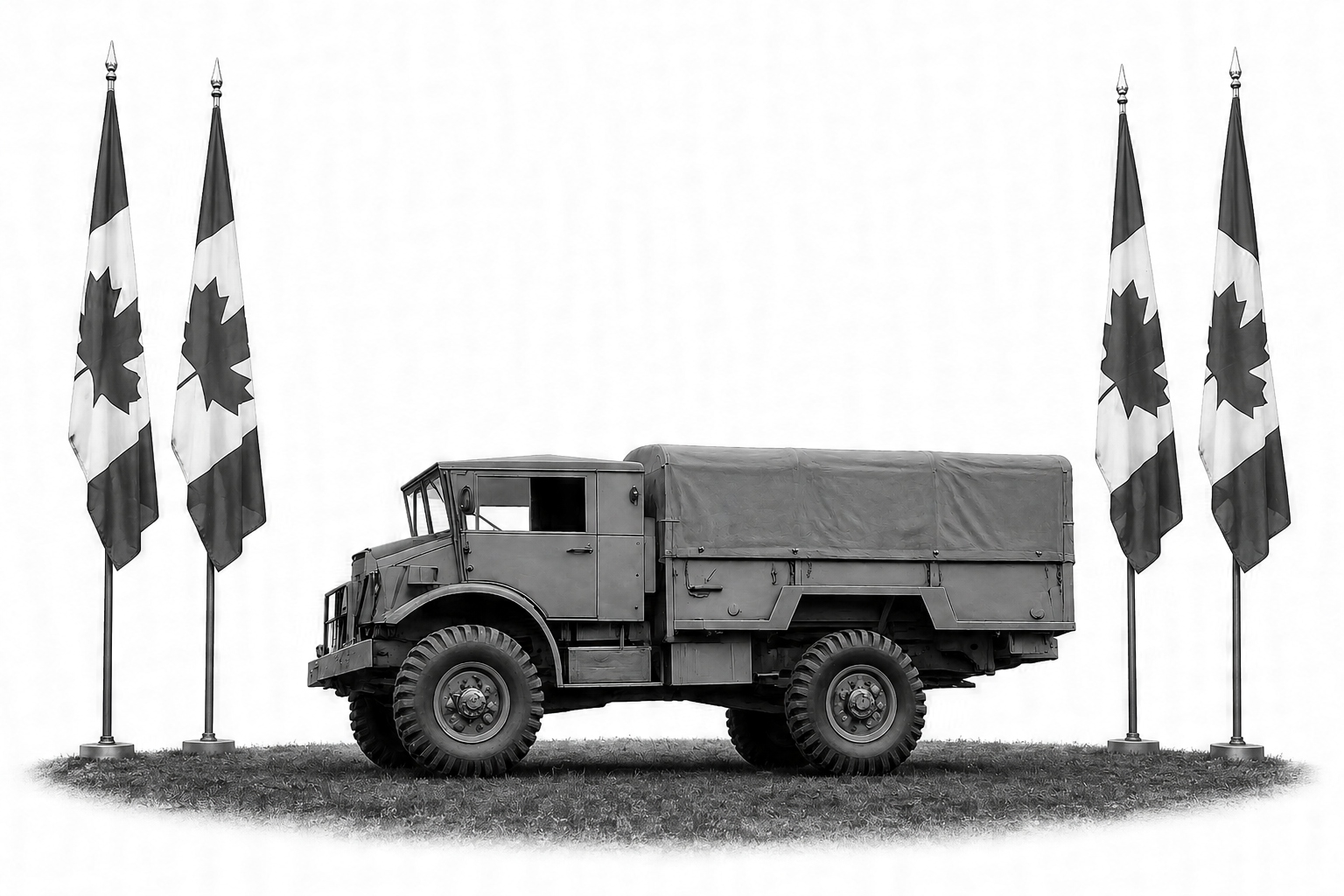
The number gets cited wrong so consistently it has almost become official. Canada built over 800,000 CMP trucks, the capsule histories say, as though a single model rolled off the lines at Windsor and Oshawa by the boxcar-load. The actual figure is more complicated and, honestly, more impressive. Canadian factories produced about 815,729 military vehicles in total during the Second World War. Of those, roughly half were Canadian Military Pattern trucks — just over 400,000. The other half were modified conventional-pattern vehicles, Bren Gun Carriers, and related military transport. Getting the number wrong undersells what Canada actually did, because the story of the CMP family is not just about quantity.
It is about a logistics system that fed an empire.
A Problem, a War Office, and Two Ontario Plants
The British came into the war in 1939 with about 80,000 military vehicles of all types. By June 1940, after the collapse in France, they had left 75,000 of them on the beaches and roads at Dunkirk. The question of where to find replacements fast enough to matter was not abstract. Britain turned to Canada.
The Canadian Military Pattern vehicle family had been in development since 1937. Canada's Department of National Defence invited Ford Motor Company of Canada and General Motors of Canada to produce prototypes for a light military truck that the British War Office had recently adopted as standard. By 1938 the program had shifted toward heavier 4x4 and 6x4 designs; by 1939 full production plans were in place. The two manufacturers were pushed toward common solutions and maximum interchangeability — a combined maintenance manual had to explicitly reconcile Ford and GM lubrication specifications, which gives some sense of how genuinely difficult that goal was. The vehicles were built with right-hand drive, reflecting the reasonable wartime assumption that the conflict would remain centred on Britain and its road conventions.
The result was not a single truck. It was a system. Ford produced seven chassis families: the F15A, F30, F60B, F60S, F60L, F60H, and the FGT field artillery tractor. General Motors produced six: the C15A, C30, C60S, C60L, C60X, and the CGT tractor. Those thirteen chassis families supported what the official 1944 Canadian Army Overseas Vehicle Data Book described as an extraordinary variety of bodies — general service cargo trucks, wireless trucks, ambulances, field kitchens, mobile workshops, office bodies, teleprinter vehicles, water carriers, and specialist six-wheel laboratory and signals units. Ninety distinct army vehicle types on twelve standard chassis. The compact chassis universe supporting a vast body universe was the whole design logic, and it worked.
The Production Numbers, Correctly
Canadian output of trucks and special military vehicles ran as follows, according to official Dominion Bureau of Statistics reporting: 113,002 in 1940; 173,588 in 1941; 216,057 in 1942 — the peak year; 178,064 in 1943; 158,038 in 1944; 130,777 in 1945. Those figures aggregate CMP trucks with modified conventional pattern vehicles and other specials. The DBS series does not break out CMP production separately, and no publicly accessible official source provides annual CMP-only figures for Windsor and Oshawa alone.
What specialist wartime production records show is that just over 400,000 standard CMP trucks were built in Canada across the whole programme — roughly half the 815,729 total military vehicle figure. The most numerous single variant was the 4x4 3-ton family, models C60S, C60L, F60S, and F60L combined from both Ford and GM, at just over 209,000 vehicles. Ford of Canada's total wartime vehicle production ran to approximately 335,000 units of all types, with peak employment at Windsor reaching 15,637 workers; Ford's own corporate reporting states that military production was practically completed by 12 September 1945. Chrysler of Canada at Windsor produced approximately 180,000 military trucks on Dodge chassis, but those used standard Dodge control cabs rather than the Ford-GM cab-over-engine body. They served in a CMP role but are not standard CMP trucks in the technical sense.
The cab-over-engine design is the visual signature. The engine sits under the cab rather than ahead of it, giving a flat-faced, functional look that became instantly recognizable from Tunisia to Burma. The wheelbase ran 101 inches on the 15-cwt family, 134 inches on the 30-cwt, and 158 to 160 inches on the 3-ton variants. The 3-ton 4x4 long-wheelbase carried 85 brake horsepower on the GM side, 95 on the Ford V-8, could ford 24 inches of water in the case of the field artillery tractor variant, and hit a top speed of 46 miles per hour.
Who Built Them
The official line says Canada did it. That is not wrong. But it strips out the people who actually did it.
The wartime production surge was not spontaneous. C.D. Howe took charge of the newly created Department of Munitions and Supply in 1940 and gained broad authority to mobilize industry, coordinate all Allied purchases in Canada, establish Crown corporations, regulate scarce supplies, and direct subcontracting across hundreds of plants. The state built facilities, trained labour, and told manufacturers what to make. The output figures are government output figures as much as they are corporate ones.
More specifically, they are the output figures of a workforce that included, at its wartime peak in 1943 and 1944, 373,000 Canadian women in munitions factories alone. Women worked the lines at Windsor and Oshawa alongside men, on vehicles, Bren Gun Carriers, and armoured hulls. The federal and provincial governments arranged day-care programs for working mothers and wartime housing for relocated labour to make the production targets possible. Any account of the CMP truck that does not include that is missing the people who made it.
Where They Went
Export-intended shares of Canada's wartime vehicle output ran at 56 percent in 1943, 58 percent in 1944, and 63 percent in 1945. That trend line is the story. Canada was not primarily equipping its own army. Of the 800,000-plus military transport vehicles built in Canada, only 168,000 went to Canadian forces. The rest went elsewhere.
Historical synthesis puts the distribution plainly: roughly a third of Canadian war production went to Canadian services, more than half to British and Commonwealth nations, and the balance to the United States and other Allied states — including the Soviet Union, to which Canadian Mutual Aid shipments included military trucks and transport-support materiel. The CMP was not a Commonwealth vehicle. It was an Allied one, and the official British history of the Second World War argued that the production of soft-skinned trucks, including the CMP class, was Canada's most important contribution to the eventual Allied victory.
Primary-source museum and archive records document CMP trucks in Tunisia in April 1943, in the Caen sector with RASC companies supplying the 43rd Wessex Division, in Italy with Canadian Army formations in front of damaged farmhouses, at Mantes-Gassicourt crossing temporary bridges in September 1944, in Burma on Rangoon quaysides during reconstruction in 1945, in New South Wales with Australian anti-aircraft searchlight batteries, at Hill Street in Singapore supervising Japanese prisoners of war, and in Utrecht in 1945 towing 25-pounders through the streets. The 1944 Vehicle Data Book specifies unit-level assignments: the C15A wireless truck served armoured regiments, armoured reconnaissance regiments, survey regiments, and brigade headquarters. The FGT field artillery tractor served Royal Canadian Artillery field regiments. The ambulance variants served RCAMC field ambulance units. The 3-ton GS truck, as the data book puts it, was used generally by all arms and services.
Surviving examples are held at the Australian War Memorial in Canberra, the Nationaal Militair Museum in Soest, and the Canadian War Museum in Ottawa, whose collection includes a 1943 GM personnel truck, a 1942 Ford truck, a field artillery tractor used in Italy and North-West Europe, and a 1944 GM ambulance. The Dutch museum's Chevrolet C15A came into Koninklijke Landmacht service directly from Allied vehicle dumps after the war, which is documentation of two things at once: how widespread the distribution had been, and how long the trucks kept working.
What Gets Lost in the Wrong Number
The 800,000 figure, applied to CMP trucks alone, is wrong. The correct number is just over 400,000 standard CMP trucks from the combined Ford and GM programmes, inside a total Canadian military vehicle output of 815,729 units. The distinction matters because the CMP story is already large enough without inflating it, and because inflating it obscures the design logic that made the trucks significant in the first place.
It was not the volume. It was the system. Thirteen chassis families, ninety body types, two manufacturers, one interchangeable parts goal, and a state-directed production machine that put 373,000 women on factory floors and turned Windsor and Oshawa into the logistics backbone of a six-continent war. The trucks showed up in every theatre, in every support arm, doing work that had no glamour and without which nothing else moved.
Nobody remembers them. That is fairly Canadian.
Behind the Story
The immediate prompt for this piece was an editorial review of a short CMP passage that contained one significant factual error: it attributed Canada's total wartime military vehicle production figure of 800,000-plus to CMP trucks alone. Correcting that required establishing what the correct CMP-specific figures actually were and where the aggregate number comes from. The core production data in this article draws on official Dominion Bureau of Statistics motor-vehicle industry reports for 1940 through 1945, Ford Motor Company of Canada annual reports for 1943 through 1945, and specialist wartime production records. The DBS series is the authoritative official source for annual output but does not isolate CMP production from modified conventional pattern vehicles and other specials; that limitation is stated explicitly rather than papered over.
A second correction applied during fact-checking: an earlier draft attributed the 209,000 figure to Ford's CMP production alone. Multiple sources confirm that 209,000 is the combined total for the 3-ton 4x4 family across both Ford and GM — the C60S, C60L, F60S, and F60L models together — not a single-manufacturer figure. The article also corrects the chain of initiative for the original 1937 design invitations: it was Canada's Department of National Defence that issued those invitations to Ford and GM, in response to British War Office specifications, not the British War Office directing Canadian manufacturers directly.
Technical specifications for chassis families, engine data, wheelbases, and unit-role assignments come from the 1944 Canadian Army Overseas Vehicle Data Book, the primary official source for CMP nomenclature in service. Operational theatre documentation draws on primary-source museum and archive holdings at the Imperial War Museums, the Australian War Memorial, and the Canadian War Museum. Distribution figures and Mutual Aid context draw on Veterans Affairs Canada official material and published historical synthesis. Labour and production-system context draws on Veterans Affairs Canada official material on wartime working conditions and women in war industry.
The Chrysler-Dodge figure of approximately 180,000 military trucks is drawn from secondary synthesis and is presented with that caveat. Claims about civilian postwar reuse of CMP trucks are not made in this article because no publicly accessible official source located during research supports them with sufficient specificity. Artificial intelligence tools were used in the research phase of this article to locate, cross-reference, and evaluate primary and official sources.