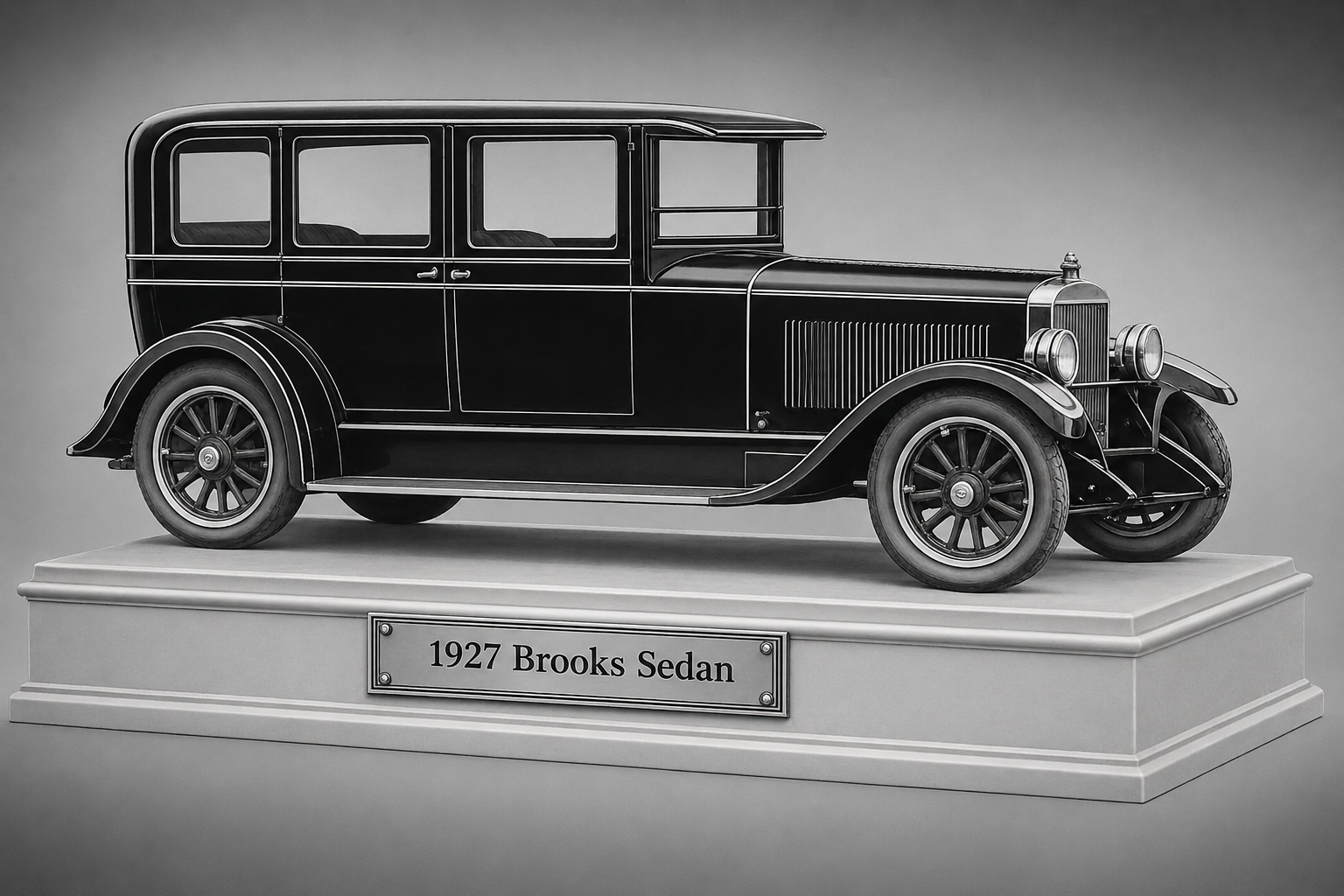
The factory is gone. Torn down in 2001, the old brick pile at 494-500 Ontario Street in Stratford had spent decades as dead storage before someone finally put it out of its misery. Avalon Fabrics had been there. Werlich Industries. Jones Manufacturing. Nobody who drove past it would have guessed what came off the floor inside, back when the building smelled of steam and piano wire and ambition.
What came off that floor -- roughly 150 to 180 of them, by the most credible count -- was the Brooks Steam Car. A fabric-bodied, two-cylinder, pot-boiler-powered sedan that its promoter called The Gentle Giant of Motion. It was built between 1924 and 1926. Priced like a Pierce-Arrow. Sold like a disappointment.
The man behind it was named Oland J. Brooks. He was an American financier from Buffalo, New York, and he had come to Toronto in 1920 with a talent for raising money and a conviction that the gasoline age was a fad. He was wrong on the second count and very right on the first.
From Detroit to Stratford, by Way of a Failed Scheme
Steam cars had been dying since before the First World War. The Stanley brothers in Massachusetts kept the faith longer than most, but by the early 1920s their company was coasting on nostalgia and inertia. Detroit Steam Motors Corporation tried to relight the fire with a car called the Trask-Detroit -- and failed, leaving behind a set of engineering drawings, a half-finished business plan, and a roster of investors with nowhere to go.
Brooks absorbed what he could from the wreckage. His new company, Brooks Steam Motors, Ltd., was incorporated in March 1923. The technical DNA of the Trask-Detroit lived on in the Brooks -- the bore and stroke dimensions, the general layout, the design philosophy. He wasn't starting from scratch. He was starting from someone else's scratch.
Stratford was the obvious choice for a factory. The town sat at the intersection of three railways -- eventually absorbed into Canadian National -- and it ran on steam. Mechanics who knew boilers, valves, and pressurised systems were everywhere. The Grand Trunk had been laying them off. Brooks showed up at exactly the right moment.
The city sold him a former threshing machine factory at 494-500 Ontario Street for $55,000. The city assumed a $50,000 mortgage on the building. Stratford was not passive in this arrangement; it wanted a car maker badly enough to finance one. In October 1923 Brooks also set up an executive office in suites 1305-7 of the Canadian Pacific Railway Building in Toronto -- a prestigious address, chosen deliberately.
That September, a prototype had been shown at the Toronto Exhibition. The crowds came. Photographs were taken. Preference shares were sold.
What the Car Actually Was
The production Brooks was a five-passenger closed sedan, the only body style that ever reached customers in any numbers. Its wheelbase measured 122 inches -- a full-size car by the standards of the day. The tyres were 32 x 4-1/2 cord.
The body was the unusual part. Not steel. Not aluminium. Fabric. The Orillia Body Company, a division of Tudhope Manufacturing, built the frames and stretched them with artificial leather from the American Auto Trimming Company over in Walkerville. Wire netting and wadding and canvas underneath. The material had a trade name -- Meritas -- and the pitch was that Meritas panels produced a total absence of rumbling and vibration, squeaks and rattles. Whether buyers believed that is unclear. Whether it was true is also unclear.
The engine was a two-cylinder unit with a 3.5-inch bore and 4.5-inch stroke, geared directly to the rear axle. Steam enthusiasts will note that a steam engine develops torque on both the forward and return stroke, which gave the Brooks a smooth, pulling power delivery that no gasoline-powered car of the era could replicate at low speeds. The advertising copy was honest about this, for once: the power remained even down to one mile per hour and less. Torque was not the problem.
The boiler was a pot type, fired by a Bunsen burner arrangement. To protect against explosion -- a real concern in the public mind, however overstated -- the boiler was wrapped in three to four miles of piano wire under tension. A smokestack came as standard equipment. The overall machine had only 38 moving parts, which the company sold as a maintenance advantage over the complexity of a gasoline drivetrain.
At $3,885 for the sedan, the Brooks cost approximately what a Pierce-Arrow cost. A Pierce-Arrow was a luxury automobile made in Buffalo, New York, with a long reputation and a wealthy clientele behind it. The Brooks was a fabric-bodied steam car made in a converted threshing machine factory in Stratford, Ontario, by a company that had existed for roughly a year.
The boiler was wrapped in three to four miles of piano wire. A smokestack came standard. It had 38 moving parts and cost as much as a Pierce-Arrow.
The Promotion
Brooks was not shy about his car. He showed one at the October 1924 London Automobile Show at Olympia, priced for the British market at 996 pounds -- at a moment when an Itala sedan cost 800 pounds and a six-cylinder Packard cost 775. The export effort went nowhere for obvious reasons.
Back in Canada, Brooks set up taxi companies in Stratford and Toronto, running his own steamers as the fleet. It was a clever move -- taxis put cars in front of the public, generated newspaper coverage, and let him argue the cars were earning their keep in commercial service. Brooks Securities Ltd., a separate Toronto company he also controlled, sold shares in Brooks Steam Motors to the public. The car and the stock were both product. The car happened to be the less important one.
By 1925 the factory employed around ninety workers, well short of the hundreds the company had promised Stratford. Letters to shareholders claimed the plant was running day and night trying to fill orders. It was not. In 1926 the company sold eighteen cars for the entire year.
Eighteen.
The Bus, the Buffalo Factory, and the Unravelling
Late 1926 brought a pivot. Brooks announced a new chapter: steam buses. He bought a factory in Buffalo, New York, incorporated a separate American holding company called Brooks Steam Motors Inc. in Delaware, and declared that the future was heavy commercial vehicles. The Stratford car operation would be wound down or relocated.
A 29-passenger prototype was built in the summer of 1927, its aluminum parlour car-style body fabricated by the Buffalo Body Company. The engine was a V8 poppet-valve unit -- eight power strokes per revolution, which Brooks compared to the output of a gasoline V16. In October that year the bus was displayed at the annual convention of the American Electric Railway Association in Cleveland, Ohio -- the main bus trade show in the United States at the time. It was the first steam-driven vehicle ever shown there. No orders were taken. The bus was presented purely as an experimental vehicle.
The shareholders had seen enough. In late 1927, following no meaningful progress in production, they took charge of the company and forced Oland Brooks out. A new engineer was brought in -- A. Clarkson, formerly chief engineer of the London Omnibus Company in England, whose father had been a pioneer in steam bus development. The car that was going to remake Canadian transportation was now being managed by a committee trying to salvage what it could.
It could not salvage much. The Canadian company entered a legal limbo as stockholders sought liquidation. The stock market collapsed in 1929. On December 15 and 16, 1931, an unreserved auction sale cleared out what remained at the factory -- cars, parts, equipment, the accumulated evidence of a decade's worth of optimism. Remaining cars sold for between $150 and $400. The building reverted to the city.
Investors had lost close to four million dollars. Brooks himself was already gone -- forced out in 1927, disappeared into Buffalo, and then further, with millions of dollars unaccounted for. After the mid-1930s there was nothing. A death notice eventually surfaced in a Florida newspaper in 1961.
What Survived
The factory walls outlasted the company by seventy years, cycling through industrial tenants before the demolition crews arrived in 2001. The cars proved more durable.
Roughly a dozen Brooks Steamers are believed to exist today. Two sit in public collections in Ontario. The Canadian Automotive Museum in Oshawa holds one -- believed to be a car once owned by a Stratford man named Lamb, and thought to retain its original tyres.
The Stratford Perth Museum holds another. In 2007, local citizens raised approximately $50,000 and the Stratford Perth Heritage Foundation used it to acquire a 1926 Brooks from a collection in Orillia -- bringing the car back to the town where it was built. The Heritage Foundation held it for seven years before conveying full-time care and exhibition to the Stratford Perth Museum in a formal ceremony in February 2014. The car is on permanent display there now, not far from the city where it was built.
Five are said to survive in Canada. Three in England. The count varies by source and year.
The Canadian Automotive Museum notes, without fully settling the question, that historians still debate whether Oland Brooks created the cars as a fraud to cheat investors or as a genuine attempt at alternative energy transportation. The debate has some merit. The car was real. The engineering was real. Steam propulsion was real. What was manufactured most efficiently, in the end, was expectation -- and preference shares.