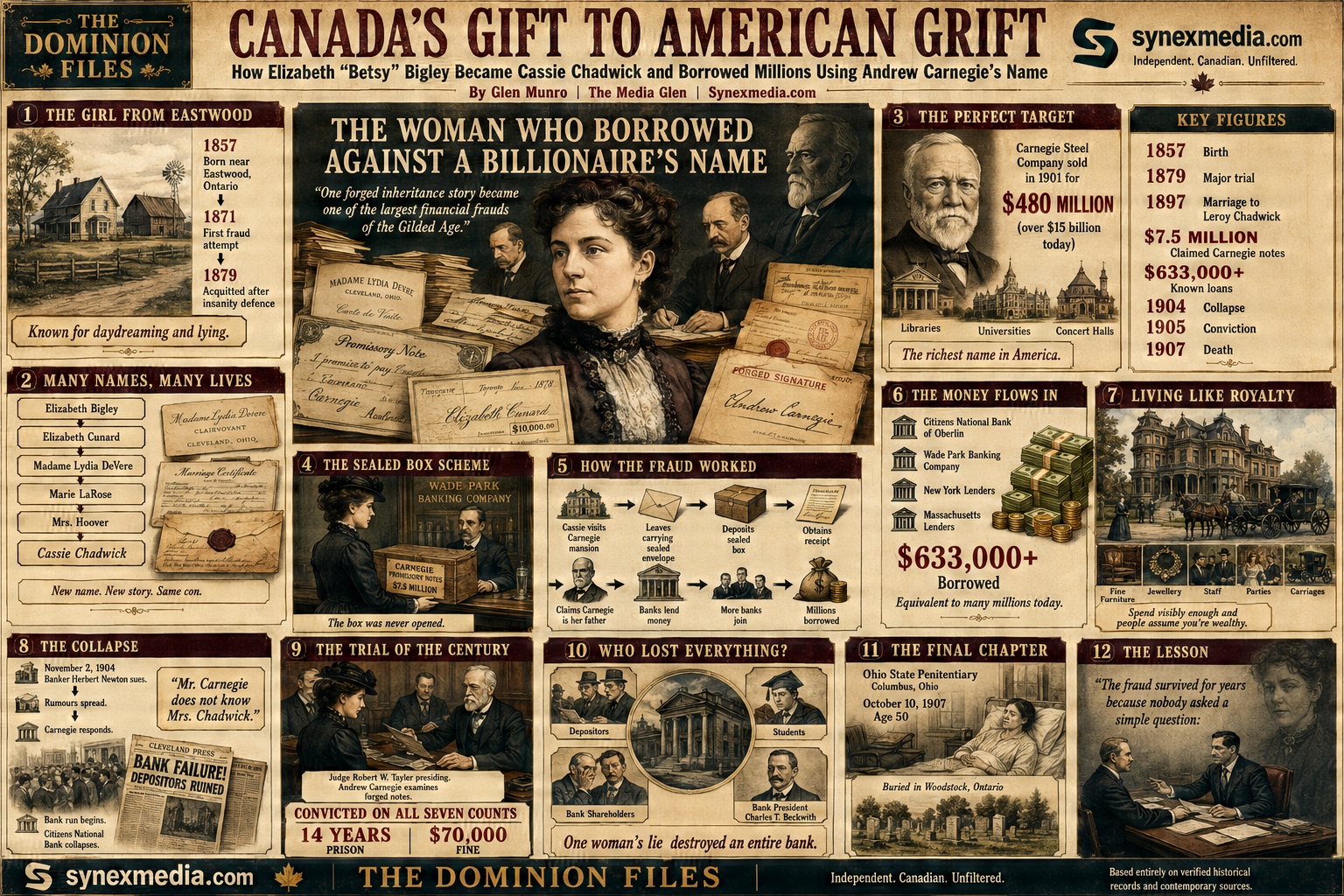
She was born on October 10, 1857. A farm near Eastwood, Ontario. Frame house, woodsmoke, a father who worked the Grand Trunk Railway's section crew and was gone often enough that the house ran on the quiet logic of a woman managing too many children and not enough of anything else. Eight kids in total. Three sisters -- Alice, Mary, Emily. A brother, William. Several others filling corners. Betsy was the third daughter, and she was known for two things above all others: daydreaming, and lying.
On their own, neither is alarming. Children fib. Most of them age out of it or learn to keep it to manageable proportions -- a broken plate, a skipped church service, the kind of small daily fiction that greases the gears of family life. Betsy Bigley didn't grow out of it. She got better at it. The way a carpenter gets better at joints, the way a surgeon gets better at cuts -- she refined the instrument until the instrument wasn't a fib anymore. It was something else. Something with architecture.
She was fourteen when she went to Woodstock.
* * *
Woodstock sat about fifteen miles from the Bigley farm. Tidy. Prosperous enough. Banks with real money in them and merchants who understood the word collateral. What Betsy Bigley offered as collateral was a letter describing a deceased uncle in England who had left her a comfortable inheritance. She'd written the letter herself. She opened a bank account. She passed worthless cheques to various merchants who looked at the document and nodded.
The whole operation had the easy confidence of someone who had been running schemes for years. She was fourteen years old and had been running schemes for roughly no years at all.
The authorities arrested her. Releasing her was easier than deciding what she was, so they released her -- on account of her age, and because there was a comfortable medical explanation available that meant nobody had to sit with the alternative. Insanity. A simple diagnosis with the advantage of not requiring you to think too hard. She went home to the farm.
Not long after, she was arrested again -- attempting to extract a promissory note worth $250 from a prosperous farmer using the same basic premise: she stood to inherit substantially and could be trusted to repay. Her father settled it. She came back.
In 1878 she tried again, larger this time. In Toronto, she presented herself as Elizabeth Cunard, of the prominent shipping family whose name opened doors without keys. A forged letter of introduction. A fraudulent cheque. Roughly ten thousand dollars' worth of goods on credit before the whole thing fell apart and she ran. The thing about Betsy Bigley is that running was never demoralising for her. It was just part of the sequence.
March 1879 brought her back to Woodstock and her most polished performance yet. She had been arrested again, this time for attempting to negotiate forged promissory notes, and she went to trial with calling cards in her possession that read: "Miss Bigley, Heiress to $15,000." She was twenty-one. The trial was March 22, 1879. Her lawyers ran an insanity defence, and she helped them by making faces at the jurors -- pulling expressions across the courtroom that suggested someone not entirely in command of her faculties. The jury believed it, or believed enough of it. She walked out free.
That tells you something about the legal system. It tells you considerably more about her nerve.
* * *
Her sister Alice had married a man named York and moved to Cleveland, Ohio. Betsy followed. After a brief stay with Alice and her husband, she rented the lower floor of a house at 149 Garden Street from a landlady named Mrs. Brown -- told Mrs. Brown she was a widow, which was at least consistent with the general direction her life was moving. Then she told Mrs. Brown she was a clairvoyant.
Of everything she ever said, this was probably the most accurate thing.
Clairvoyance is the business of convincing people you know things you could not possibly know. Which was, stripped down to its mechanism, exactly what she had been doing since she was old enough to write a forged letter. She set herself up as Madame Lydia DeVere, put on the appropriate atmosphere, and began telling the futures of Cleveland residents who had more faith than sense. It paid decently. It also kept her in practise, which was the point.
She went through names the way most people go through addresses. Lydia Scott for a while. Madame Lydia DeVere again. As Madame Marie LaRose, she married a farmer from Trumbull County, Ohio, named John R. Scott -- a man who believed he had found something extraordinary, until she convinced him to sign a prenuptial agreement and then, roughly four years later, swore out a confession of adultery in a Youngstown lawyer's office and filed for divorce. The confession was against herself. She filed her own. Even Betsy Bigley's exits had production value.
On November 21, 1882, under her actual name, she married Dr. Wallace S. Springsteen of Cleveland. Physician. Civil War veteran. A man of standing who made the error of believing that a man of standing was difficult to deceive. He discovered the truth of his new wife's history approximately twelve days after the wedding and had her removed from the house. He paid her debts -- which gives you a certain picture of the man's character -- and filed for divorce, which was granted in early 1883.
After Springsteen came C.L. Hoover, a wealthy Cleveland businessman. She married him. Had a son, Emil, born around 1886, and sent the boy to Canada to be raised by her parents on the Eastwood farm. Hoover died in 1888. She inherited what there was of his estate, reassumed the name Madame Lydia DeVere, and according to a period account in the Clinton Republican, sustained a lavish lifestyle by securing large sums of money from various men through methods the newspaper declined to specify at length.
By 1889 she had been married three times, divorced twice, widowed once, and was known to Cleveland investigators as a practised forger.
In January 1890, she and a man named Joseph Lamb were arrested for forging the signature of C.F. Brown, a wealthy Toledo iron manufacturer. The trial produced something genuinely novel: Lamb's defence attorney argued that his client had acted under her hypnotic influence, in what was reportedly the first time such a claim had been made in an American courtroom. The jury found it persuasive. Lamb went free. She was convicted and sentenced to nine and a half years in the Ohio State Penitentiary in Columbus.
She served about four of them. In 1893, Ohio Governor William McKinley -- who would later occupy the White House and then a mahogany casket after Leon Czolgosz shot him at the Pan-American Exposition in Buffalo -- signed the paperwork for her release on parole. She returned to Cleveland. She opened a brothel on the city's near west side. She met Dr. Leroy S. Chadwick, a wealthy widower and one of Cleveland's more respected physicians, under circumstances that have circulated in various colourful forms.
What is certain is this. They were married on February 5, 1897, in Allegheny County, Pennsylvania. He knew nothing of Elizabeth Bigley or Lydia DeVere or Mrs. Hoover or any of the rest of the long catalogue. He married Cassie L. Chadwick, widow, and brought her to his home on Euclid Avenue.
Euclid Avenue was Cleveland's Millionaires' Row. The woman who had been forging letters of inheritance since she was fourteen years old had finally arrived at a house that looked like the thing she'd been pretending to inherit.
* * *
What Betsy Bigley understood -- and this is worth sitting with, because it is not an ordinary understanding -- was that wealth in the Gilded Age was a theatrical production. The fortunes of Carnegie, Rockefeller, Morgan, Vanderbilt: real enough in their origins, but what sustained the system around them was not the actual money. It was the belief in the money. Bankers extended credit on that belief. Merchants extended account on it. The entire apparatus of Gilded Age finance ran on the assumption that the monuments were solid, and the assumption was so widely shared that almost nobody thought to check.
She spent four years on Euclid Avenue performing solvency at a level that impressed even the genuinely solvent. Furniture of a quality that made suppliers weep with gratitude. Art. Music on a scale that required staff to arrange and guests to witness. She ran accounts everywhere, paid regularly enough that nobody panicked, and asked for more. The question that went unasked in every merchant's office, in every banker's waiting room, was a simple one: where, specifically, was this money coming from?
Around 1902, she answered it. For certain people. In carefully chosen company.
The story she told was this. She was Andrew Carnegie's illegitimate daughter.
Carnegie by this point was one of the wealthiest men alive. He had sold Carnegie Steel to J.P. Morgan in 1901 for $480 million and walked away with a personal share that defied ordinary arithmetic. He was giving it away as fast as he could manage -- libraries, concert halls, universities, the whole philanthropic machinery of a man racing to spend a billion dollars before death collected him. His Fifth Avenue mansion in New York had been completed in 1902. His name, spoken in a banker's office, was not a name. It was an event.
She visited that mansion. She went on some pretext, spent perhaps twenty or thirty minutes inside, and came out carrying a sealed envelope. What she did inside is not on record. What she did next is.
She went to the Wade Park Banking Company in Cleveland and deposited a sealed box with the cashier, a man named Ira Reynolds. The box, she allowed Reynolds to understand, contained promissory notes bearing Andrew Carnegie's signature. The total value of the notes was seven and a half million dollars. Reynolds issued her a receipt describing the contents as she had described them. He never opened the box. Why would he? The receipt said Carnegie's name. In the financial architecture of 1902, that was a foundation.
Then she went to the banks.
* * *
Her claim, in the private conversations that opened wallets, was that the Carnegie connection was a secret he needed kept -- that he had provided the notes and securities as a form of permanent arrangement to ensure her silence and her comfort, and that she stood to inherit from a man worth somewhere between $300 and $400 million. The institutions that loaned her money were not, in their own understanding, lending to Cassie Chadwick. They were writing loans against the future estate of Andrew Carnegie.
The loans came in.
The Citizens' National Bank of Oberlin -- a federally chartered institution in the Ohio college town, the kind of steady small-city bank that existed to finance farms and small businesses and the educations of the town's children -- loaned her money on a scale that eventually exceeded its total capital. The bank's president, Charles T. Beckwith, loaned so much of the bank's funds that the bank's continued existence depended entirely on her repayment. Then, because apparently the first abyss wasn't deep enough, he loaned her more than one hundred thousand dollars of his own personal money. The Wade Park Banking Company held the sealed box and the receipt. Lenders in New York and Massachusetts added their contributions. The total that changed hands has never been established with precision. The figure that appeared most often in contemporaneous accounts was $633,000. Other estimates ran considerably beyond that.
She spent it at a pace that still, more than a century later, induces a kind of admiring horror.
The Euclid Avenue household was a money-consuming apparatus of the first order. Jewellery. Furniture. Staff -- cook, housekeeper, assorted others. The entertainments she threw for Cleveland society were by all accounts spectacular, the kind that get remembered not because the guests were enjoying themselves but because the scale of it seemed impossible and that impossibility was precisely the point. She paid her debts just often enough that nobody's lawyer sent a letter. The structure depended on perpetual motion: borrow large, spend visibly, convince the next lender that someone who lives like this has always lived like this and always will.
On November 2, 1904, a banker from Brookline, Massachusetts, named Herbert B. Newton decided he had waited long enough for repayment on a loan of $190,800. He filed suit. That was the sound the whole structure had been waiting to make -- one sharp, definitive crack -- and then the rest of it came down.
Word moved through the Cleveland banking community with the speed of contagion. Word eventually reached Carnegie, who issued a statement in December 1904. It was brief and it was lethal. "Mr. Carnegie does not know Mrs. Chadwick of Cleveland," the statement read. "Mr. Carnegie has not signed a note for more than thirty years."
The Citizens' National Bank of Oberlin experienced a depositor run almost immediately. The bank collapsed. Charles T. Beckwith, ruined in every sense of the word, wept openly. He was charged with misapplying bank funds. He died before his case could be tried, which was perhaps the only mercy the situation offered.
She had gone to New York. On December 8, 1904, United States Marshal William Henkel arrested her at the Hotel Breslin. She was in bed when they came. She was wearing a money belt. The money belt contained more than one hundred thousand dollars in cash. She had presumably intended to use it for something, though nobody got to ask her what.
* * *
The federal trial opened in Cleveland in late February 1905. Judge Robert W. Tayler presided. The charges were conspiracy against the United States government and conspiracy to wreck a federally chartered bank -- the Citizens' National Bank of Oberlin. Seven counts in total. She denied everything, including, with a certain breathtaking specificity, that she had ever claimed any connection to Andrew Carnegie whatsoever.
It became a national spectacle in the way that only a few trials manage. Newspapers ran daily accounts of testimony, evidence, courtroom behaviour. Carnegie himself attended -- by most accounts out of undisguised curiosity, and when he entered the courtroom he reportedly gave the defendant a long, measured look that said nothing and meant everything. He examined the forged promissory notes. He was not flattered. "If anybody had seen this paper and then really believed that I had drawn it up and signed it," he said, "I could hardly have been flattered." He pointed out errors in the spelling. He noted the punctuation. He mentioned, again, that he had not signed a note of any kind in thirty years.
The jury convicted her on all seven counts on March 10, 1905. Judge Tayler sentenced her to fourteen years in the Ohio State Penitentiary and a fine of seventy thousand dollars. She received the sentence in hysterics.
Bank cashier A.B. Spear was convicted separately and received seven years. Beckwith was beyond the law's reach. Carnegie, learning that Oberlin students and ordinary depositors had lost their savings in the bank collapse she had engineered, made a substantial personal donation to cover their losses. The Oberlin Carnegie Building was completed in 1907 -- the same year its involuntary patron died in prison.
* * *
She entered the Ohio State Penitentiary in Columbus in January 1906. Prison, it turned out, was a poor environment for her particular talents. The health she had maintained through three decades of baroque criminal enterprise came apart quickly once there was no enterprise left to maintain. By October 1907 she was in the penitentiary hospital. She had refused throughout, entirely and consistently, to admit to any of it. No confession. No inventory of the damage. No account of where the money went after it left the banks and entered the household on Euclid Avenue. She kept her story all the way to the end.
On October 10, 1907 -- her fiftieth birthday -- Elizabeth Bigley of Eastwood, Ontario, died of heart failure in the Ohio State Penitentiary hospital in Columbus.
Six days later, on October 16, she was buried in the Anglican Cemetery on VanSittart Avenue in Woodstock, Ontario, not far from where she had first practised her craft on the merchants of that tidy market town. The tombstone reads: "Elizabeth Bigley wife of L.S. Chadwick, M.D. 1859-1907." The birth year is wrong by two years. The name is the last and most respectable of her many names. The whole inscription has the quality of a final editorial decision -- a woman who spent her life writing her own story, editing herself one last time in stone. The date she gave the mason was wrong in precisely the direction you would expect from someone who had been shaving years off her age since she was old enough to know that age was information she could control.
Her son Emil, born in Cleveland around 1886, appears in the 1900 United States census as Emil Chadwick. He had been sent to Canada as an infant to be raised by her parents on the Eastwood farm. What he was told about his mother, or when, is not recorded. The Chadwick mansion on Euclid Avenue near East 82nd Street attracted curious visitors for a time after her death. It was torn down in the early 1920s.
Carnegie outlived her by twelve years. He died in August 1919, having given away more than $350 million, built 2,509 libraries, and endowed concert halls from Pittsburgh to Edinburgh. He never publicly commented further on the woman who had borrowed against his name for the better part of a decade or on the fact that no one, in all that time, had simply picked up a pen and written him a letter to ask.
The letter would have taken three minutes to write. The postage would have cost a few cents. The whole elaborate structure of the fraud -- the sealed box, the receipts, the bankers weeping in their offices, the collapsed institution in the Ohio college town, the federal trial before a full gallery -- all of it could have been ended at any point in the seven or eight years it ran by the simplest possible act of due diligence. Nobody did it.
That is the part of this story that doesn't go away. Not the woman who built the machine. The men who ran it for her, for years, because they wanted what she was selling more than they wanted to know if it was real.
* * *
Behind the Story
The research question was specific: which claims in the standard Cassie Chadwick narrative hold up against contemporaneous sources, and which have hardened into fact through repetition across accounts that source each other rather than primary records? The answer, after extended verification, is that the biographical spine is solid and a small number of circulating details are not.
The birth date, October 10, 1857, and the Eastwood, Ontario location are confirmed by the Oxford County Library's local history collection, a major biographical research database, and contemporaneous death and burial records. A conflicting account places the birth at Appin, Canada West, with a subsequent family move to Eastwood. The Oxford County sources, drawing on local documentation, are treated here as the more specific authority on location.
The Grand Trunk Railway connection and the father's role as section boss are confirmed across multiple independent sources including a Woodstock-area regional history archive and a biographical database drawing on local documentation. A 1949 magazine account of the Eastwood fraud names the Great Western Railway instead; the Grand Trunk attribution is the majority finding across more recent and more authoritative sources.
The two Woodstock incidents are treated throughout as distinct events: the age-14 release (circa 1871) on grounds of youth and the March 22, 1879 formal trial and acquittal. Multiple sources confirm the 1879 trial date, the calling-card text, the insanity defence, and the acquittal.
The marriage to Leroy Chadwick on February 5, 1897, in Allegheny County, Pennsylvania, is confirmed by a primary record in a major genealogical database, cited in an independent biographical profile. The three prior marriages are confirmed across the Encyclopedia of Cleveland History, Wikipedia, and the Ohio History Connection. The detail that John R. Scott specifically grew wheat has been removed from this version; no source examined identifies his specific farming activity, and unverifiable embellishments are excluded here throughout.
The Ohio State Penitentiary is in Columbus, not Toledo. An earlier version of this article incorrectly described the sentence as being served "in Toledo," which was the site of the federal district court for the 1890 forgery conviction, not the location of the prison. This has been corrected. The conviction and nine-and-a-half-year sentence are confirmed by the Encyclopedia of Cleveland History and a major biographical research service.
The Carnegie visit to the New York Fifth Avenue mansion is confirmed by multiple sources including a major American cultural history magazine and the Clio historical database. The Fifth Avenue mansion was completed in 1902.
The Ira Reynolds / Wade Park Banking Company receipt is confirmed by a contemporaneous major newspaper account describing Reynolds accepting a sealed box and issuing a receipt for its stated contents without inspection.
The November 2, 1904 suit filing date and the precise loan figure of $190,800 come from the Encyclopedia of Cleveland History. The December 8, 1904 arrest date at the Hotel Breslin and the name of the arresting marshal are confirmed by a contemporaneous newspaper account published the same day.
Carnegie's attendance at the trial is reported consistently across a major American cultural history magazine, a state women's history database, and multiple publications citing period newspaper sourcing. No primary trial transcript confirming his physical presence was located in the sources available for this piece; the claim is included on the consistent weight of secondary-source reporting with apparent period newspaper origins. His quoted remarks about the forged notes are directly attributed in multiple independent secondary sources citing a contemporary newspaper interview.
The conviction on seven counts, the fourteen-year sentence, and the $70,000 fine are confirmed by the Encyclopedia of Cleveland History, Wikipedia, and a state women's history database. A minority source gives the sentence as ten years; the fourteen-year figure is the majority finding across more numerous and more authoritative sources.
Beckwith's death before trial and Spear's seven-year conviction are confirmed by a major biographical research service. Carnegie's donation to Oberlin depositors and the 1907 Oberlin Carnegie Building completion are confirmed by the Clio historical site.
The death date of October 10, 1907, in the Ohio State Penitentiary hospital in Columbus, is confirmed by a major biographical research service, a major genealogical record database, and a contemporaneous newspaper obituary. The burial date of October 16, 1907 -- six days after death -- is confirmed by the genealogical record database memorial and a biographical record database. The Anglican Cemetery, VanSittart Avenue, Woodstock, and the tombstone inscription are confirmed by the genealogical record database memorial.
The total amount borrowed was not established with certainty during or after the trial. The $633,000 figure is from a major American cultural history magazine as the documented minimum; other estimates run considerably higher. The article presents this as an unresolved range.
Carnegie's death in August 1919, the $350 million charitable total, and the 2,509 libraries are drawn from the general historical record and standard Carnegie biographical sources.
AI assistance was used in research compilation, fact-checking, and editorial review. All factual claims in this article were individually verified against named sources before inclusion. Claims that could not be verified against at least one credible documented source were excluded.