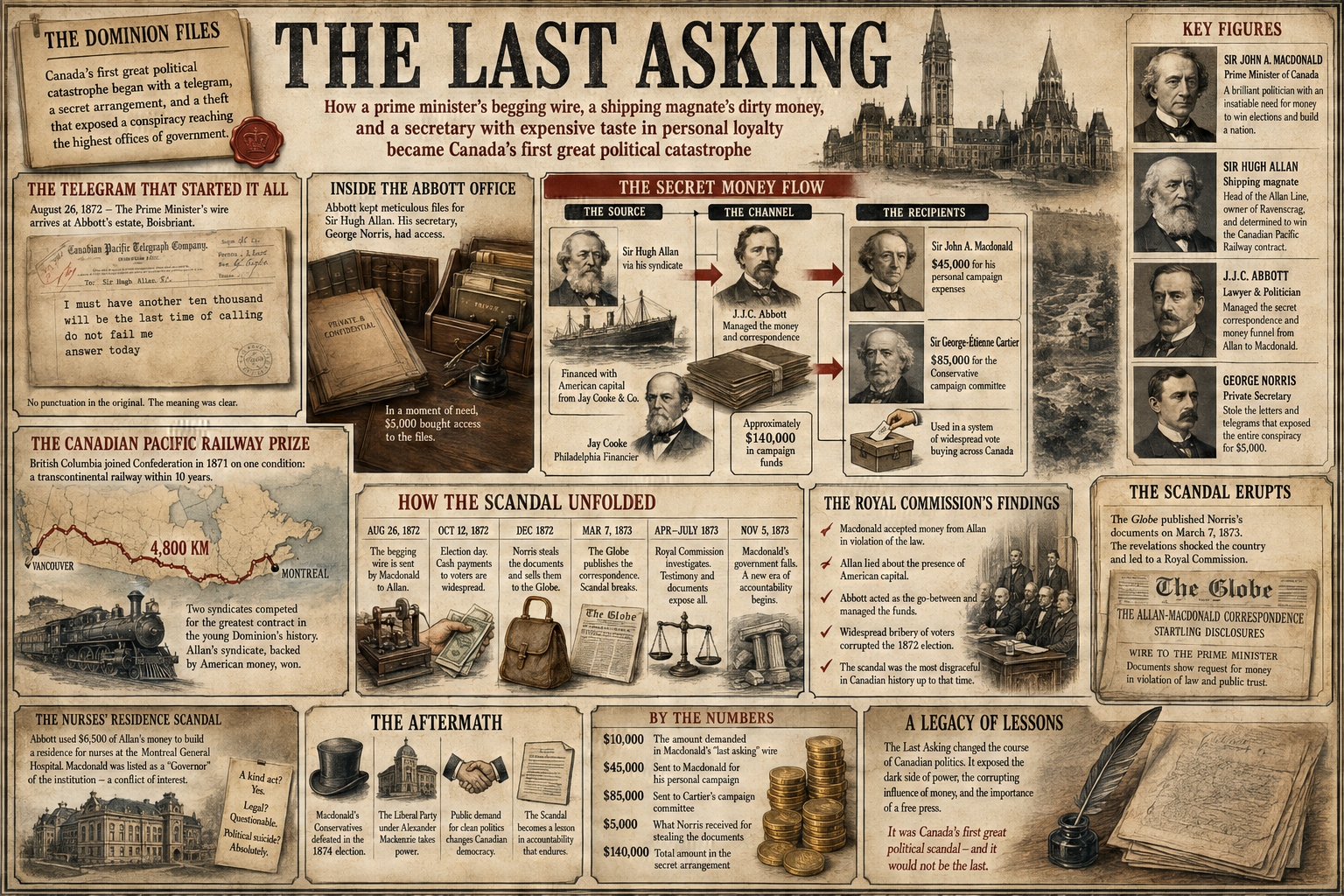
The estate at Sainte-Anne-de-Bellevue had a name, Boisbriant, which is the kind of detail that only becomes relevant once you know its owner kept excellent files. John Joseph Caldwell Abbott had been practising law in Montreal for twenty-six years when August 1872 arrived. He was methodical. When the Prime Minister's wire reached the estate on August 26, he filed it alongside the rest of the correspondence he was holding for Sir Hugh Allan — cables, letters, the accumulated paper record of an arrangement its participants had agreed should not exist in writing, and had then committed to writing with the thoroughness of men who trusted their own filing systems more than they should have.
He trusted his private secretary with the office.
George Norris worked at Abbott's Montreal law firm. He had access to the files. This is not the most dramatic origin story for one of the great document thefts in Canadian political history, but it is the true one — an inside man, a disorganised calendar, and about $5,000 worth of Liberal money changing hands for correspondence that would bring down a government.
What the wire said was not long. "I must have another ten thousand; will be the last time of calling; do not fail me; answer today." The semicolons are editorial, added by the transcribers who prepared the correspondence for the 1873 Royal Commission; the original telegram, like all telegrams of the period, carried no internal punctuation. But the meaning survived the transcription intact. The Prime Minister needed campaign money. He needed it from Allan. He needed it that afternoon.
Sir John Alexander Macdonald had been governing Canada for five years when he sent it. He had practised law, served in the pre-Confederation legislature of the Province of Canada, and spent the better part of two decades arguing, negotiating, drinking, and occasionally threatening his way toward the 1867 Confederation agreement. He was not a man with an uncomplicated relationship to money or to the sources of it. What he had was a country that needed a railway, a railway that needed a financier, and a financier who was prepared to be helpful in ways that exceeded what was technically legal.
* * *
British Columbia had not been enthusiastic about Confederation. The condition it extracted before joining in 1871 was explicit: a transcontinental railway connecting the Pacific coast to the existing country within ten years. Macdonald agreed. He then encountered the actual geography, which ran to roughly 4,800 kilometres of Precambrian Shield, Rocky Mountain, and everything difficult in between, and which required someone to supply the money for it in amounts that the federal government of a three-and-a-half-million-person country was not positioned to cover on its own.
Two syndicates formed to pursue the contract. David Macpherson organised one from Toronto. The other came from Montreal, from a man who had built the largest privately held shipping operation serving the North Atlantic routes to Canada and had never, in four decades of commercial life, encountered a contract he did not want.
From Saltcoats, Ayrshire, by way of a Montreal counting house he had entered as a teenager in 1826, the man who wanted that contract had spent four decades building the largest shipping operation serving the North Atlantic routes to Canada. By 1872 the Allan Line ran with the regularity of a public utility. His mansion on the slope of Mount Royal, Ravenscrag, announced his position in terms that required no elaboration. He had been knighted in 1871 for services to ocean navigation and immigration — a gesture that, even at sixty-one, Hugh Allan accepted as somewhat overdue. The railway contract was the next thing to collect.
His syndicate was financed with American money.
What Cooke needed in Canada was an agent, and Picton, Ontario, had produced one. George William McMullen, born there in 1844, was by the early 1870s the Canadian representative of Jay Cooke's Philadelphia financial operation — the same firm underwriting the American Northern Pacific Railroad. Cooke's interest in Allan's syndicate was not complicated: whoever built Canada's transcontinental line would determine the cross-border traffic patterns that made or broke the Northern Pacific's finances. McMullen brought the Cooke capital. Allan accepted it, told Macdonald the syndicate contained no American partners whatsoever, told McMullen something else entirely, and proceeded on both tracks with a confidence that would have been admirable in a less scrutinised environment.
Macdonald's instructions had been unambiguous. No American capital. The Canadian Pacific Railway would be Canadian-controlled. He had said this clearly and more than once, in writing. Allan's written reassurances had been equally clear. The paper trail on both ends of the contradiction was immaculate.
* * *
The 1872 federal election ran staggered across the country from July 20 to October 12. There was no secret ballot in most of Canada at that point — you declared your vote aloud, in public, in front of your neighbours, your employer, your landlord, the man you owed money to, and anyone else who happened to be standing in the same field. Cash payments to voters were standard practice, largely unenforced, and considered a normal cost of doing the democratic business. What distinguished the Conservative operation in 1872 was not that it used money. It was the scale.
From Allan, through channels Abbott helped manage, approximately $45,000 reached Macdonald's own campaign expenses — including the $10,000 the August 26 wire was demanding. Some $85,000 went to the electoral committee of Sir George-Etienne Cartier; he was fighting his Montreal East seat against unexpected difficulty and needed the money badly. Minister of Public Works Hector-Louis Langevin received roughly $32,600. When Allan's total contributions to Conservative candidates across the country were tallied before the Royal Commission, they came to more than $350,000. In 1872 dollars. From one man.
The Conservatives won 99 seats to the Liberals' 94 in a 200-seat House. In September 1872, the CPR contract went to Allan's Canada Pacific Railway Company. Allan was named president. The arrangement had reached its intended conclusion.
* * *
Lucius Seth Huntington was the Liberal MP for Shefford, Quebec, and on April 2, 1873, he rose in the House of Commons without a single document in hand. He had McMullen's account of events. McMullen — frozen out of the CPR contract once Macdonald required Allan to dissolve all American partnerships — had spent the preceding months in a state of energetic grievance, and that grievance had found a productive channel. Huntington's motion formally alleged that Allan's syndicate had been financed with American capital, and that Allan had advanced large sums to Cabinet ministers in exchange for the railway charter.
Macdonald's majority defeated it by 31 votes.
But the allegation was now on the parliamentary record. It existed. And McMullen still had copies of certain correspondence.
* * *
George-Etienne Cartier died in London on May 20, 1873. Bright's disease. He had been ill for some time — the kidney condition had been worsening through the election campaign he had fought the previous autumn, through the parliamentary session that followed, through the months of mounting pressure on his government. He was buried in Montreal. The stolen letters were still in Liberal hands when he died, not yet published, not yet a matter of public record. The timing has the quality of a grace that history occasionally extends to the powerful and revokes with interest in the long term.
* * *
Sometime in the weeks after Huntington's motion, Norris and an unidentified confederate removed from Abbott's Montreal law office the correspondence that Allan and Abbott had left there for safekeeping while they were in England seeking British investment. The documents passed through channels that eventually connected to Huntington. McMullen had almost certainly facilitated the acquisition. Norris had the access. The $5,000 was paid, the files changed hands, and by early July 1873 the Liberals had the physical evidence to accompany the story they had been telling since April.
On July 4, 1873, the Montreal Herald and the Toronto Globe published the correspondence. Front pages, both. The Globe ran its presentation down an entire column — headlines stacking like a building coming apart, the text of Macdonald's August 26 wire reproduced in full. The country read it over breakfast and went to work and talked about it and came home and talked about it more. Entire populations can absorb a complicated story quickly when the story contains a telegram that reads "do not fail me; answer today."
* * *
On August 13, 1873, Parliament rose. The following morning, Macdonald's government established a Royal Commission to investigate Huntington's allegations. The chair was the Honourable Charles Dewey Day. He had sat on the Court of Queen's Bench; he was also the first Chancellor of McGill University, a biographical detail that history has declined to make much of. The Liberals declined to participate, having noted that the commission investigating the accused government had been appointed by the accused government, a structural arrangement they found inadequate.
Lord Dufferin wrote to Macdonald that summer. The Governor General's language was careful. His meaning was not. The Prime Minister's personal connection with what had passed, Dufferin observed, could not but fatally affect his position as minister. This was a man doing his constitutional duty and recording, at the same time, his private conclusion.
Parliament reconvened October 23. The censure debate began. Conservative members who had been representing thin majorities in thin constituencies began to reassess their mathematics.
* * *
On the evening of November 3, 1873, Macdonald stood and spoke for five hours.
His fellow minister Peter Mitchell supplied him with tumblers of gin during the speech. Mitchell later recorded the experience with the bemused restraint of a man who had done what he considered a favour and discovered it was not an exclusive arrangement — upon delivery, he found that two other ministers had independently made the same calculation and were running the same supply line. He was philosophical about it. The mental excitement of the crisis, Mitchell noted in the account later published by historian A.L. Burt, would naturally enable a man to withstand a considerable quantity of liquor. Canadian parliamentary memoir does not often achieve this level of gallantry.
What Macdonald said at the end of those five hours, in the passage that survived into Hansard, was: "I throw myself upon this House; I throw myself upon this country; I throw myself upon posterity, and I believe — and I know — that, notwithstanding the many failings in my life, I shall have the voice of this country, and this House, rallying around me."
That is not the language of a man who expects to win. It is the language of a man composing his own memorial.
* * *
On the evening of November 4, Donald A. Smith rose and spoke.
On the Conservative benches, the silence everyone was watching belonged to Donald A. Smith, the Member for Selkirk, Manitoba, who was also the Chief Commissioner of the Hudson's Bay Company in Canada and a man of substantial weight in the young Dominion's economy. For days he had kept both sides of the House in a state of agonised suspension, his position undefined, his vote unannounced. Men on both sides had read that silence as whatever they needed it to be. When he declared he could not support the administration, the result of the formal vote became a formality itself.
Macdonald drove to Rideau Hall the following morning and tendered his government's resignation before the vote was taken. Not required to. He went anyway. Alexander Mackenzie was sworn in as Prime Minister on November 7.
In Perthshire they had trained him as a stonemason; in Sarnia he had built houses. By the time politics claimed him he had a clear set of convictions about what sound construction required — load-bearing material, measured work, no ornament that didn't serve the structure. Alexander Mackenzie brought that approach to the Prime Minister's office on November 7, and in almost every observable respect was the opposite of the man whose office it had been. He immediately set about governing.
Macdonald's caucus was offered his resignation from the party leadership the same week. They declined it.
* * *
The Dominion Elections Act received royal assent on May 26, 1874 — after the January 22 election, which had been conducted under provisional arrangements pointing in the same direction. Secret ballot. Uniform polling day across constituencies. Contested election petitions removed from parliamentary committees and handed to the courts. The practice of standing in a public square and announcing your vote within earshot of everyone who could punish you for it was finished, federally, in Canada. The January election had already returned 133 Liberals against 73 Conservatives, which suggested the country had formed a view.
* * *
Macdonald sat in opposition. He was fifty-eight years old. The expectation in 1874 was that he was done — that a man who had presided over the most thoroughly documented act of political corruption in the country's history, who had been demonstrated in his own handwriting to have solicited campaign money in exchange for a government contract, would accept the verdict and recede from public life at a reasonable pace. He studied the expectation and set it aside.
The 1878 election was held September 17. The Conservatives won 137 seats against the Liberals' 69 in a 206-seat House. The National Policy — protective tariffs, railway construction, Western settlement — had given Macdonald a platform the electorate preferred to Mackenzie's record. He was sworn in again on October 17, 1878, and governed until the morning of June 6, 1891, when he died in office in Ottawa. Nineteen years total at the head of the country. He had been building the thing, in one capacity or another, for the better part of four decades, and he was still building when he stopped.
* * *
The aftermath distributed itself among the surviving participants with the tidiness of a good short story.
Abbott — the lawyer, the careful filer, the man whose professional reputation had absorbed a substantial blow from the events at his own law office — became Canada's third Prime Minister on June 16, 1891, succeeding Macdonald nine days after his death. He served until November 24, 1892. He was the first Canadian-born Prime Minister. He had not sought the position and was documented as finding it disagreeable. "I hate politics," he wrote to a correspondent not long into his tenure, which is not an attitude generally considered optimal in a head of government but which, given the circumstances under which he had arrived at the office, is at least understandable.
Donald Smith — the man whose speech on the evening of November 4, 1873 had signalled the end of the government — reconciled with Macdonald and became a director of the syndicate that actually built the Canadian Pacific Railway. On November 7, 1885, at a mountain pass in British Columbia called Craigellachie, Smith drove the last spike of the completed transcontinental line. He was sixty-five years old. His first swing bent the spike. He drove it home on the second. He was later made Baron Strathcona and Mount Royal. The man who had broken the Pacific Scandal government drove the last spike of the railway the Pacific Scandal had been about, which is either a moral about persistence or a moral about Canada, and in practice is probably both.
* * *
The wire Macdonald sent on August 26, 1872 survives in the historical record. The semicolons in every printed version are editorial — the Royal Commission's transcribers supplied the punctuation that telegraph transmission stripped away. What the original contained was the plain fact of a Prime Minister asking for money, urgently, in the confidence that the man receiving the request would understand the situation and act on it before dark.
He was not wrong about that. He was not, in the end, wrong about much of it. The country concluded in 1878 that a plan for its economic future outweighed a six-year-old telegram, and returned the man who sent the telegram to the office from which he had sent it. Whether that judgment was principled or convenient is a distinction that has never, in any country that holds elections, been as large as either side wants it to be.
The railway got built. The country remained. And the building, as it turned out, was sound even when the contractor had been billing irregularities.