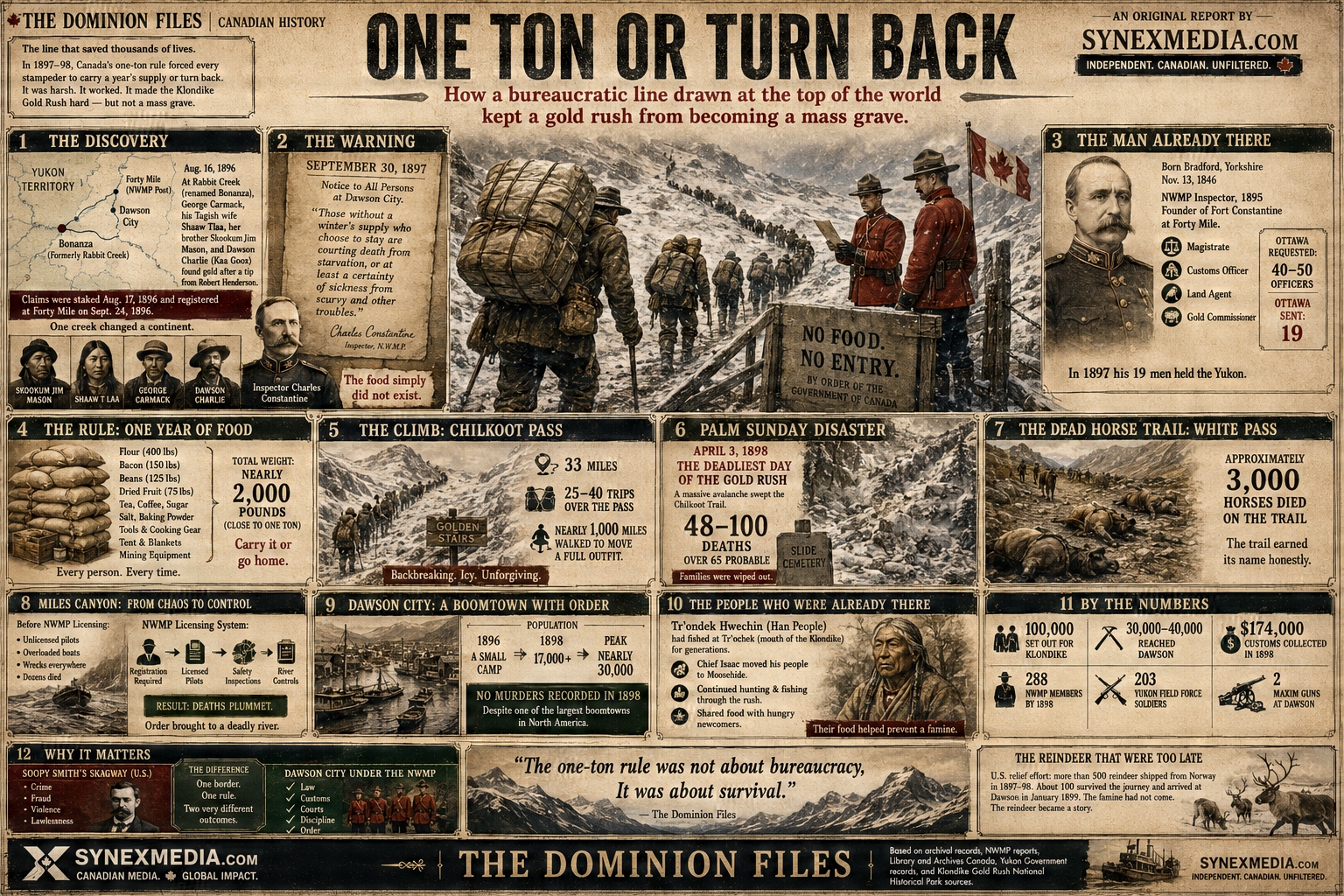
The notice went up in Dawson on 30 September 1897. Hand-written. Nailed where people could see it.
Inspector Charles Constantine of the North-West Mounted Police had done the arithmetic and the arithmetic was bad. The food stock on hand could not feed the people already in the district. His words were not dressed up, not softened for the audience. Those without a winter's supply who chose to stay were, he wrote, courting death from starvation, or at least a certainty of sickness from scurvy and other troubles. One path out: move downriver to Fort Yukon, now, before the river closed.
Fourteen months after that notice, somewhere between thirty thousand and forty thousand people were crossing mountain passes in the dead of winter, each of them hauling close to a ton of food and equipment, each of them stopped at the Canadian border and checked by men in scarlet tunics who had Maxim guns and the authority to send them back.
There is a straight line between those two moments.
Canada drew it.
The Discovery
Rabbit Creek. That is what they called it before the world found out what was in it. A tributary of the Klondike River, unremarkable on any map, running through country that most men in Ottawa could not have located with both hands and a lantern.
On 16 August 1896, a party that included American prospector George Carmack, his Tagish wife Shaaw Tlaa, her brother Keish -- known as Skookum Jim Mason -- and Kaa Goox, called Dawson Charlie, found gold there after a tip from Canadian prospector Robert Henderson. Gold enough to change everything.
Claims were staked the following day, 17 August 1896. Formal registration happened at the NWMP post at Forty Mile on 24 September 1896. The creek was renamed Bonanza. Yukon marks 17 August as Discovery Day.
The claim went into Carmack's name. The party had reasoned, correctly, that mining authorities were unlikely to honour a title held by an Indigenous person. Skookum Jim, by most accounts the sharpest prospector in the group, registered nothing. His gold. Somebody else's name on the paper.
The Canadian government was not ready for any of this, there was one NWMP officer in the entire Yukon district.
The Man Already There
Charles Constantine was born in Bradford, Yorkshire, on 13 November 1846. He had come to Canada as a young man, made his career in police work, and in 1894 the NWMP sent him north with Staff Sergeant Charles Brown on a scouting trip that lasted a few weeks. He assessed the territory, came back, and told Ottawa to send forty to fifty mounted men.
Ottawa sent nineteen.
In 1895 Constantine returned with that small force and built Fort Constantine at Forty Mile -- the first NWMP post in the Yukon Territory. He was inspector, magistrate, land agent, gold commissioner, and customs officer all at once. In his first full season with the force in place, his detachment collected $3,248.82 in customs duties. He filed reports. He documented conditions. He put his observations in writing and mailed them to people who were busy with other things.
Then August 1896 happened.
By the following summer, men who had spent the winter picking gold out of Bonanza Creek were loading steamships in San Francisco and Seattle. The news hit like a weather system. Historians put the total number who set out for the Klondike at around one hundred thousand; somewhere between thirty and forty thousand of them actually reached Dawson City. The rest peeled off along the way -- turned back at the border, wrecked on the river, stopped by weather or money or plain common sense.
Autumn in Dawson, 1897
Dawson in the autumn of 1897 was a town running short on everything that mattered. Several thousand people, most of them living on what the steamboats had brought upriver before freeze-up, were staring at a winter with inadequate food stocks. Constantine counted what was on hand. It was not enough.
His 30 September notice was logistics, not drama. He urged the unprovisioned to move downriver to Fort Yukon before the ice closed. A few hundred took his advice. The rest stayed and rationed what there was -- beans, biscuits, whatever stretched. It held together. Barely. Constantine knew "barely" was not a policy.
The following winter, tens of thousands more were coming.
South of the border, the United States government had received the starvation reports and responded the way governments respond when they want to do something dramatic and useful and end up doing something dramatic and memorable. On 18 December 1897, President William McKinley signed legislation appropriating $200,000 for Klondike relief. The plan was to purchase more than five hundred reindeer in Norway, ship them across the Atlantic, load them onto railcars, transport them to Seattle, sail them north, and drive them over the Chilkoot Pass to Dawson City.
Of the more than five hundred animals that left Norway, roughly one hundred were still alive when the journey ended. They reached Dawson in January 1899. By then the feared famine had not materialized, the saloons were serving champagne, and the reindeer -- having given everything -- became a story people told at parties.
Canada's approach was less theatrical. It was also considerably more effective.
The People Who Were Already There
Before the prospectors, before Constantine, before the fort -- the Han people of the Tr'ondek Hwechin had worked a seasonal fish camp at Tr'ochek, at the mouth of the Klondike River, for generations. It was their place long before any of the relevant names on any of the relevant maps had been drawn.
Within a month of the August 1896 discovery, the site was overwhelmed. Chief Isaac agreed to move his people downriver to Moosehide, about five kilometres from what was becoming Dawson City. They relocated first to an NWMP reserve across the river, then to Moosehide over the winter of 1897 to 1898.
They did not, quietly disappearing into that displacement, stop contributing to the territory. Tr'ondek Hwechin men and women packed goods, guided routes, cut firewood, drove sled dogs, hunted, and sold meat and fish to the prospectors flooding their land. During the starvation winter of 1897 to 1898, it was their hunters providing moose meat to Dawson that kept the worst from happening. Most of the gold rush literature is about the stampeders. The people displaced to make the rush possible had their own kind of hardship -- less dramatic, longer-lasting, and less often written about.
Superintendent Steele
By January 1898, Samuel Benfield Steele was fifty years old and had a biography that read like a rough draft of Canadian history. Born 5 January 1848 at Medonte Township in what is now Ontario, son of Royal Navy Captain Elmes Yelverton Steele -- Napoleonic Wars, the whole thing -- he had been largely fending for himself since his early teens. His mother died when he was nine. His father, 1865.
He joined the militia in 1866 during the Fenian raids, served as a private in the Red River Expedition of 1870, and in 1873 was the third officer sworn into the newly formed North-West Mounted Police, entering as staff constable. He was on the March West of 1874. He helped arrange Treaty 6 negotiations in 1876 and Treaty 7 in 1877. He had command of B Division at Fort Qu'Appelle by 1880, was policing the Canadian Pacific Railway workforce from 1882, commanded Steele's Scouts through the 1885 North-West Rebellion -- fighting at Frenchman's Butte and Loon Lake -- and established the post in British Columbia that would carry his name. He married Marie Elizabeth de Lotbiniere Harwood on 15 January 1890. They had three children, including a son, Harwood, who became a writer.
The Canadian government, facing international criticism over the Klondike chaos, sent Steele north in January 1898 under orders from Clifford Sifton, Minister of the Interior. The assignment was direct: get to the Chilkoot and White passes, establish customs posts, impose order on the entry points, and prevent the territory from turning into a catastrophe.
He sailed to Skagway in January 1898 and stepped into what he would later describe as "little better than a hell on earth."
Hell on Earth, American Side
Jefferson Randolph Smith -- Soapy to everyone who knew him, which was everyone -- ran Skagway through extortion, fraud, and the kind of casual violence that convinces a town to stop asking questions. By the summer of 1898, Skagway had between eight thousand and ten thousand residents, making it the largest city in Alaska. It was effectively a criminal organization with a post office and a main street.
Steele had no authority there. Skagway was American territory. The people streaming through it toward the Canadian border were entirely at Smith's mercy until they hit the NWMP line at the mountain summit, which was a considerable mercy gap.
Smith was killed on 8 July 1898. The Shootout on Juneau Wharf. The coroner's inquest credited vigilante guard Frank Reid with the fatal shot; Reid died of his own wounds on 20 July. A letter from Steele suggests another guard, Jesse Murphy, may have fired the killing shot. Nobody settled it. Both of the men most likely to know were dead.
The Rule
Whether the ton-of-goods requirement was Steele's idea is a question the historical record does not cleanly answer. The Government of Yukon credits Commissioner James Morrow Walsh, who spent a difficult winter in the territory in 1897 and 1898 and reportedly ordered the year's-supply requirement at Lake Bennett and Tagish afterward. Most popular histories give the credit to Steele, who enforced it with the most visible authority from January 1898 onward. Constantine's September 1897 warning was the direct precedent for all of it. Authorship is genuinely contested. What is not contested is what the rule did once Steele put his weight behind it.
The mathematics were not complicated. Three pounds of food per person per day for a full year produced a minimum food weight of 1,095 pounds -- just over half a ton. The standard outfit lists of the period added to that: 400 pounds of flour, 150 pounds of bacon, 125 pounds of beans, 25 pounds of rolled oats, ten pounds each of tea and coffee, 25 pounds of sugar, 25 pounds of dried potatoes, 75 pounds of dried fruits. Then clothing, tools, tent, cooking equipment, mining gear. The total approached two thousand pounds per person. Per person.
The NWMP posts at both passes did not negotiate.
Customs collection began at the Chilkoot summit on 26 February 1898, when Inspector R. Belcher raised the flag at the top. Between February and June of that year the Mounties collected $174,000 in duties -- roughly $4.9 million in present-day money. At one point, per the Galt Museum's NWMP institutional history, Belcher had $90,000 sitting in a bag under his bed, which says something about the improvised nature of frontier administration and also about Belcher's nerves. The force in the district grew from 96 men in 1897 to 288 by 1898, backed at Fort Selkirk by the Yukon Field Force -- 203 soldiers of the Permanent Force, with two Maxim guns and enough ammunition to make the point clearly.
Anyone who reached the summit without a year's provisions was turned back down the mountain. That was the policy. That was all of it.
The Climbers
The White Pass out of Skagway was lower than the Chilkoot -- 873 metres at the summit against the Chilkoot's 1,067 -- and longer, and it looked manageable to people who had never seen what passes like that do to pack animals. Roughly three thousand horses died on the White Pass trail. Photographer Asahel Curtis saw the wreckage in 1897 and noted the animals "were strewn along this trail, mostly on the two-mile slope west of the pass." The trail got a name from what happened there. Dead Horse Trail. It is still called that.
Most stampeders took the Chilkoot instead, the shorter route out of Dyea, 33 miles to Lake Bennett through terrain that wanted to kill them. Near the summit, above a waystation called the Scales where loads were weighed before the final approach, rose a stretch called the Golden Stairs -- roughly 1,500 steps cut into snow and ice, nearly vertical, the last 1,000 feet to the border. On a busy day the line of climbers ran from the base to the summit with no gap. Single file. One after another.
A stampeder carrying a 50-pound pack needed somewhere between 25 and 40 trips to move a full outfit over the pass. Every trip up was a trip back down empty. The National Park Service has estimated that a man moving his own gear walked close to 1,000 miles to advance his supplies the 33 miles from Dyea to Lake Bennett. Many quit partway through. Their loads sat at the base of the mountain for a while and then were gone.
Tlingit packers -- mostly Alaska Native men who had worked these mountains their whole lives -- hired out for roughly one cent per pound carried. They knew the snowpack. They knew when conditions turned. In early April 1898, when the Tlingit refused to pack above Sheep Camp because the slopes above looked wrong, the stampeders who ignored that judgment and kept climbing found out why.
Palm Sunday. 3 April 1898.
A series of avalanches came down near the Scales after days of heavy snow. Tents, supplies, people -- all of it buried in a debris field spanning hundreds of yards. The death toll was never established with precision: the National Park Service puts the probable count at over 65, with documented range running from 48 to nearly 100. Rescue crews dug for days. The bodies of those recovered lie in the Slide Cemetery near Dyea. It was the single deadliest event of the entire gold rush.
Miles Canyon
Past the summit, past Lake Bennett, past the lakes and portages, there was still 550 miles of river between a stampeder and Dawson City. Miles Canyon and the Whitehorse Rapids were where the river made its feelings known. When Steele came through the area in February 1898, roughly 7,000 people were camped at Canyon City, about a kilometre south of the canyon mouth, waiting for the spring ice break-up.
When the ice went, the boats went with it -- into the canyon, many of them sideways. Somewhere between 150 and 300 craft were wrecked in the first days of open water. At least five men drowned. Steele, writing about it years later in his memoir, noted that the low casualty count was itself mysterious to him.
In June 1898 he closed the canyon to unlicensed operators. Only qualified pilots could take boats through. Women and children walked the portage. Every vessel -- boat, scow, canoe -- was numbered and registered at Tagish Post, with names, addresses, and next-of-kin recorded for every soul aboard. Violators had their outfits seized. Entrepreneur Norman Macaulay built a horse-drawn tramway around the worst of it, five miles of track on the east bank, built in 21 days. The drownings stopped.
Steele described the registration system in his memoir, Forty Years in Canada, published in 1915: "One of the first things I caused to be done after I arrived at Lake Bennett was to have every boat, scow and canoe numbered... the names and addresses of every man, woman and child, the names and addresses of their next-of-kin, and the number of their boat, were recorded at Bennett and Tagish in books kept for the purpose."
The books exist. They are in the archives.
Dawson
"Deposits of unimaginable kinds of filth." That is how Steele described Dawson City when he moved his headquarters there in September 1898. He had been appointed to the Yukon Territorial Council on 7 July 1898 -- the warrant is held in the Sir Samuel Steele Fonds at the University of Alberta -- and he took on licence commissioner and chair of the board of health alongside his policing command. None of these were ceremonial.
Dawson had grown from nothing in 1896 to roughly 17,000 people by the summer of 1898, population approaching 30,000 at the peak. It was built of wood, isolated, and without adequate sanitation -- a typhoid outbreak waiting for the right conditions. The right conditions arrived. By the end of 1898, nearly 100 people had died of the disease.
Steele's first act as chair of the board of health was to order every bartender in Dawson to boil the water before putting it in drinks. Then came drainage ditches, sanitation works, a proper jail beside the barracks -- heated all winter by the labour of convicts, which struck contemporaries as efficient. Fines from lawbreakers funded community services. Mining licences and royalty collection were transferred to the police, replacing a system miners had complained was corrupt.
And in 1898, with a population in the tens of thousands and the ordinary chaos of a boom town concentrated in one muddy settlement, Dawson recorded no murders. Around 150 serious arrests. More than half of those were for prostitution, which Steele regulated through monthly fines directed to the hospital rather than trying to eliminate through enforcement that would not have worked anyway.
Dawson was not peaceful because its residents were peaceable. It was orderly because the NWMP was there and Steele ran the NWMP.
The End of the Rush
The Yukon Territory had been created by federal statute on 13 June 1898. In less than two years Canada had gone from having essentially no administrative presence in the territory to governing a city of tens of thousands, with courts, councils, licensing systems, and royalty collection running simultaneously. The machinery was in place before most of the stampeders arrived to use it.
It did not matter much to the late arrivals. By the summer of 1898, every claim worth having was taken. The creek beds had been worked. A man who reached Dawson in August 1898 found a boomtown with no room in it for him -- not in the ground, anyway. Some took wage work at the mines or in the sawmills. Most went home.
News of gold at Nome, Alaska, reached Dawson in the summer of 1899. Approximately 2,500 people left Dawson alone in August and September. The rush to Nome was the rush from the Klondike, more or less, and the Klondike was done.
Steele's departure followed shortly. He was a Conservative man working inside a Liberal administration, and that particular arithmetic had been running against him for some time. In September 1899, after nearly two years of near-total command of the most difficult policing assignment in Canadian history, he was given abrupt orders to hand over his post and take the first available boat south. No reason given. Thousands of Dawson residents came to the docks.
He left.
He took leave from the NWMP and accepted command of Lord Strathcona's Horse, a cavalry regiment raised and privately funded by Lord Strathcona (Donald Smith), appointed lieutenant-colonel effective 7 March 1900. He led the regiment in the South African War, then commanded a division of the South African Constabulary until 1906. He returned to Canadian military service, and when the First World War opened in 1914, he was made a major-general. He was knighted KCMG on 1 January 1918.
He died 30 January 1919 in London. Both influenza and diabetes are cited by the sources.
His body was returned to Winnipeg months later. The Manitoba Historical Society records it as the largest funeral western Canada had ever seen. He was buried on 3 July 1919, twenty years almost to the month after the last Klondike stampeders walked away.
What It Was Worth
By the mid-1890s the Laurier government had been looking seriously at disbanding the North-West Mounted Police. The force cost money. Its original purpose -- imposing order on the newly opened western territories -- looked less urgent as settlement advanced. There were serious parliamentary discussions about whether to keep it at all.
The Klondike ended those discussions. The NWMP had taken a chaotic mass migration of one hundred thousand people, filtered it through two mountain passes in killing cold, prevented a famine, built a functioning administrative city in the subarctic, kept the peace through a typhoid epidemic, and done all of it while simultaneously asserting Canadian sovereignty against American pressure at the border. The contrast with Skagway -- under Soapy Smith's criminal operation until his death in July 1898 -- was visible to the entire watching world. In 1904, King Edward VII granted the "Royal" prefix. The force became the Royal North-West Mounted Police.
The scarlet-tunic mythology that followed was built on something real.
The one-ton rule was a bureaucratic requirement. A customs line. Men with notebooks checking how much flour you were carrying before they let you into the country. There was nothing romantic about it and nothing intended to be. Constantine posted a notice because people were going to die if he didn't. Walsh or Steele or both of them drew the enforcement line because people were going to die if they didn't. The men who carried the food up the mountain -- 25 trips, 40 trips, close to a thousand miles of walking to move 33 miles of supplies -- were not doing it because Canada asked nicely.
Some of those people turned back at the summit and went home. The ones who went through took everything with them.
And most of them survived.
Behind the Story
The starting question for this piece was simple and turned out not to be: did the ton-of-goods rule actually save lives, or was it enforced rigour on top of conditions that would have resolved themselves anyway? The research answer is that the two things cannot be separated. The rule created conditions that made survival possible. The terrain, the winter, and the sheer scale of the migration would have made survival impossible without it.
Primary research drew on the NWMP institutional record as compiled in the Galt Museum's North-West Mounted Police history; the U.S. National Park Service's Klondike Gold Rush National Historical Park documentation, which holds primary photographic and material evidence from both sides of the passes; the Smithsonian National Postal Museum's exhibition records, which reproduce the full text of Constantine's 30 September 1897 starvation notice; the Dictionary of Canadian Biography entries for both Charles Constantine and Samuel Steele; the Sir Samuel Steele Fonds at the University of Alberta, which holds the original 7 July 1898 Territorial Council warrant and Steele's incoming 1898 correspondence; the Government of Yukon's Commissioner history, which is the source for the contested Walsh attribution for the supply rule; and the White Pass and Yukon Route Railway's institutional history for railway construction and operational dates. The Manitoba Historical Society's published account of Steele's burial confirmed the funeral details and the date of 3 July 1919.
Several figures in this article are confirmed estimates rather than audited historical counts. The Palm Sunday Avalanche death toll -- over 65 probable, with a documented range of 48 to nearly 100 -- reflects genuine record gaps from 1898: the Slide Cemetery has identified remains but the total buried under the debris was never established. The roughly 3,000 dead horses on the White Pass traces to Pierre Berton's 1958 account and is supported by Asahel Curtis's contemporaneous 1897 photograph caption. Dawson population figures (approximately 17,000 in summer 1898, approaching 30,000 at peak) are drawn from sourced estimates that reflect impossible-to-audit rapid population turnover. The typhoid death figure of nearly 100 by end of 1898 appears consistently across multiple secondary accounts; the precise figure is in NWMP annual reports at Library and Archives Canada that were not directly consulted for this article.
Three specific claims from an earlier draft were removed after failing verification: the precise date and vessel name for Steele's January 1898 departure to Skagway (the month is confirmed; the date and ship name require direct consultation of the Steele Fonds or Forty Years in Canada); a quotation attributed to Bishop Bompas regarding the Tr'ondek Hwechin's pricing of supplies to miners (the quotation could not be located in any accessible primary source); and specific amenities attributed to the Scales waystation near the Chilkoot summit (those amenities are documented at Sheep Camp and Canyon City, not the Scales specifically).
The attribution of the supply rule to Steele, Walsh, or departmental policy was left openly contested because that is the honest condition of the available evidence. No published primary document settles it. The Government of Yukon credits Walsh; most popular histories credit Steele. Both framings have institutional sources. The NWMP Commissioner's Annual Reports for 1897 and 1898, held at Library and Archives Canada, are the most likely documents to resolve the question for a researcher with direct access.
This article was researched and drafted with AI assistance. Every factual claim was independently verified against named primary or authoritative secondary sources before inclusion. Claims that could not be verified were removed from the article. The voice, structure, editorial judgements, and decisions about what belongs and what does not are the author's own.