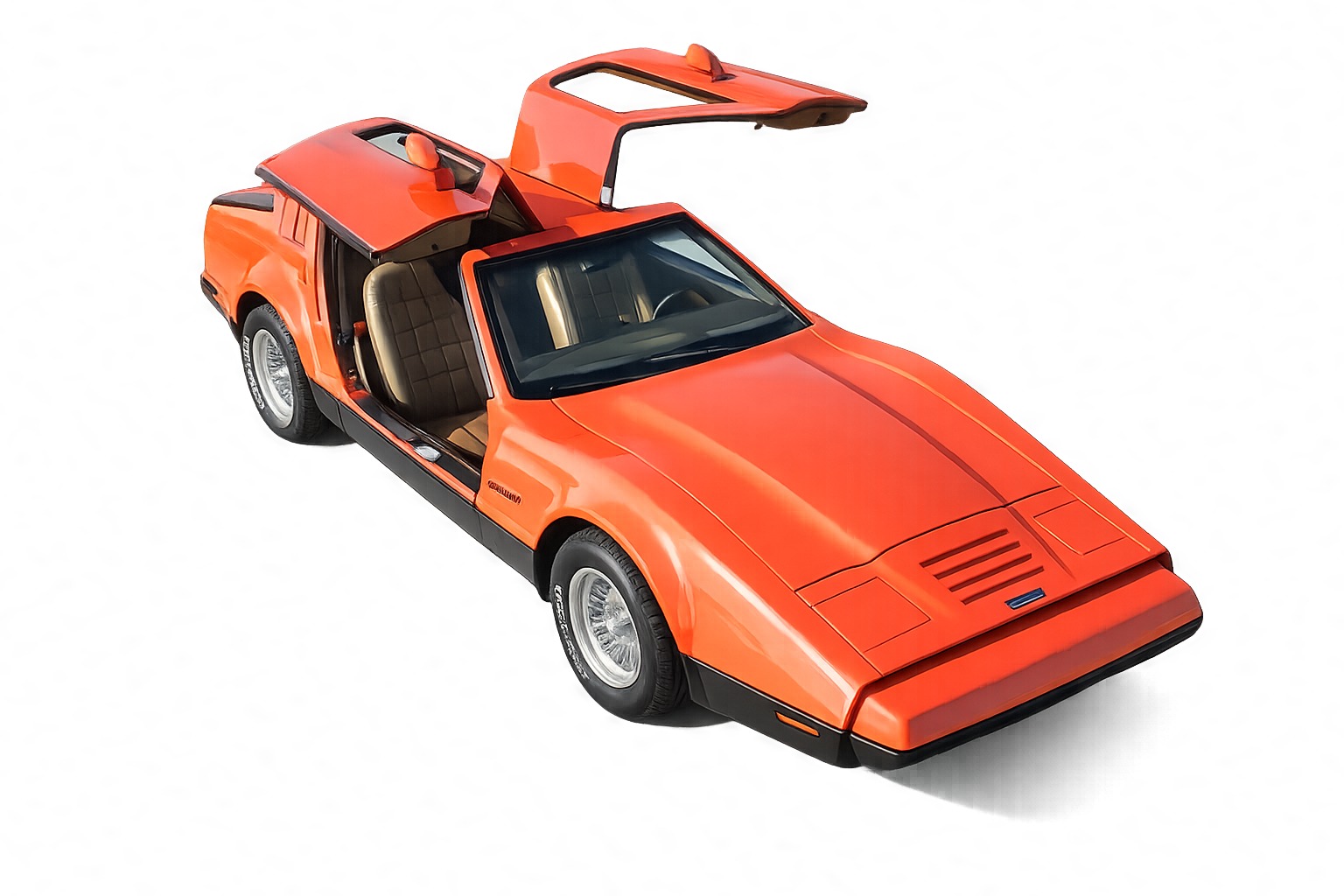
Saint John smelled like diesel fuel, wet rope, cigarettes, and the inside of a government chequebook left open too long.
That was the atmosphere in 1974 when the first Bricklin SV-1s began rolling together in New Brunswick. Men showed up at the factory carrying thermoses and union opinions. Somebody had painted SAFETY VEHICLE ONE on the side of this strange plastic missile with gull-wing doors, and for a little while people talked about it the same way prairie towns talk about UFO sightings. Half the population believed. The other half waited for the fire.
Canada had built cars before, certainly. McLaughlin. Russell. Frontenac. Beaumont. Acadian. Names scattered through old brochures and dead dealerships. But Bricklin looked different. Those earlier machines had roots in ordinary automotive bloodlines. Bricklin looked like it had landed from somewhere else after killing its pilot.
Low nose. Sharp angles. Doors that opened upward like a crow spreading its wings over roadkill.
Kids loved it. Politicians loved it more.
A Province in Search of a Miracle
The province needed a miracle then. Mills closed. Young people left town carrying hockey bags and resentment. Mining communities shrank into themselves. The Atlantic economy had developed that exhausted expression old dogs get near the end of winter. Premier Richard Hatfield's government wanted industry people could point at with pride instead of apology. Then Malcolm Bricklin arrived carrying promises big enough to require reinforced shelving.
He already had a reputation in the automotive business. American. Loud. Confident in the manner of men who think gravity operates more as a recommendation than a law. Before New Brunswick, he helped introduce Subaru to the American market. He understood salesmanship. Not ordinary salesmanship either. Revival-tent salesmanship. The kind where a fellow tells you the future is parked outside and all you need to do is sign here.
New Brunswick signed.
The company established operations in Saint John while important body-panel work took place in Minto, a coal town better acquainted with dirt and hard luck than futuristic sports cars. Somebody there must have stared at the first SV-1 shell and wondered whether they were assembling automobiles or props for a science-fiction picture filmed on a discount budget.
Safety Vehicle One
The car itself was ambitious in the way chainsaws are ambitious.
Bricklin called it the SV-1 because safety formed the centrepiece of the marketing campaign. Large energy-absorbing bumpers. Integrated roll structure. Acrylic bonded to fibreglass body panels. The body colour supposedly ran throughout the material itself so scratches would not expose bare metal underneath. That was the theory anyway. Theory lives comfortably in boardrooms. Theory eats steak dinners. Factory floors are less forgiving.
The bonding process became a nightmare almost immediately.
Panels cracked. Panels warped. Panels rejected by quality control piled up like giant coloured potato chips behind the plant. Workers fought the materials every day. Fibreglass dust coated clothing, skin, lungs, coffee cups. The production line slowed. Management panicked. Deadlines came and went carrying switchblades.
And those gull-wing doors. Christ.
They looked magnificent when they worked. A Bricklin parked outside a restaurant in 1974 attracted attention the way fistfights attract attention. Men abandoned conversations mid-sentence just to stare at it. Somebody opening those doors in a Maritime shopping-centre parking lot might as well have unveiled a spacecraft.
But the hydraulic system could behave like a spiteful appliance. Weak battery? Trouble. Electrical hiccup? Trouble. Some owners learned to keep one eye on the fuel gauge and the other on the doors, wondering whether the damned things planned to strand them inside the car like trapped lab rats.
The Mechanical Reality
The earliest 1974 SV-1s carried AMC 360 V8 engines. Some came with four-speed manual transmissions. By 1975 the company switched to Ford's 351 Windsor V8 and abandoned the manual option. Supplier issues played a part. So did survival instinct. Bricklin spent those years trying to plug holes in a sinking ship while still advertising luxury cruises.
Money vanished fast.
The New Brunswick government poured millions into the project. Early provincial financing reached roughly $4.5 million before the numbers climbed into uglier territory. Hatfield's administration believed the factory could help modernize the province's economy and image. Instead, the project developed the smell of overheated wiring.
Quality problems spread through the market. Suppliers became difficult. Costs climbed. Reports circulated about absenteeism and management dysfunction. Arguments erupted over production figures and finances. Every week seemed to introduce another problem large enough to need its own office.
The broader North American automotive market offered no mercy. The Auto Pact years had tied Canada tightly to the American automotive industry. Ford, Chrysler, and General Motors dominated the continent with giant manufacturing networks and production systems refined through decades of repetition. Bricklin entered that world carrying enthusiasm, provincial financing, and a car assembled from materials behaving like they held personal grudges.
A small company can survive one serious manufacturing problem. Maybe two.
Bricklin collected them like hunting trophies.
Why People Still Wanted One
Still, people wanted the cars. That remains the strange part. Even after stories about defects and delays spread through dealerships, the SV-1 kept its strange glamour. It looked reckless. It looked expensive. It looked like something a dentist might buy after leaving his wife for a cocktail waitress named Lorraine.
And maybe that mattered more than reliability for a while.
Production totals still drift depending on the source. Some historical summaries round the figure to roughly 3,000 vehicles produced between 1974 and 1976. Collector organizations and marque historians usually cite 2,854 cars total, including 772 built for the 1974 model year. Most remaining units came together during 1975, with leftover inventory later completed or sold as 1976 models after the company collapsed.
Collapse
By late 1975 the operation had become politically toxic. Provincial support turned controversial as costs mounted and production targets slipped away. Lawsuits appeared. Layoffs followed. Investors circled the wreckage. Inside the factories the mood shifted from optimism to suspicion. Men arrived for work wondering whether the paycheques would clear.
Then came silence.
Industrial silence has weight to it. Anybody raised near mills or shipyards understands that. A dead factory sounds wrong even when nobody speaks. Air moves differently through abandoned buildings. Loose sheet metal rattles. Fluorescent lights hum over machinery no longer earning its keep.
Bricklin died there.
The Legend That Wouldn't Stay Dead
But the car itself refused burial.
Collectors began hunting surviving examples. Owners formed clubs. Mechanics developed odd little pockets of expertise devoted entirely to resurrecting these troublesome plastic wedges from the dead. The failures became part of the attraction. Maybe the main attraction. Anybody can restore a successful automobile. It takes a certain type of person to devote years resurrecting a machine famous for eating money and humiliating accountants.
Then Canada performed one final act of national weirdness.
In 2003 the Royal Canadian Mint commemorated the Bricklin SV-1 in its transportation coin series. Somewhere along the line this failed New Brunswick sports car transformed from industrial cautionary tale into heritage object. That says something peculiar about the country. Canadians have always loved glorious failures almost as much as victories. Maybe more.
The surviving Bricklins still appear at car shows. Yellow. Red. Orange. White. Strange as carnival rides. Old men stand beside them telling stories about hydraulic doors and production numbers while younger people stare at the cars trying to decide whether they are beautiful or ridiculous.
Most settle on both.
And somewhere in rural New Brunswick there is probably still an abandoned garage holding one beneath dust sheets and rusted tools. Dead battery. Flat tires. Acrylic panels dulled by time. Waiting for another optimist to walk through the door carrying jumper cables and impossible ideas.