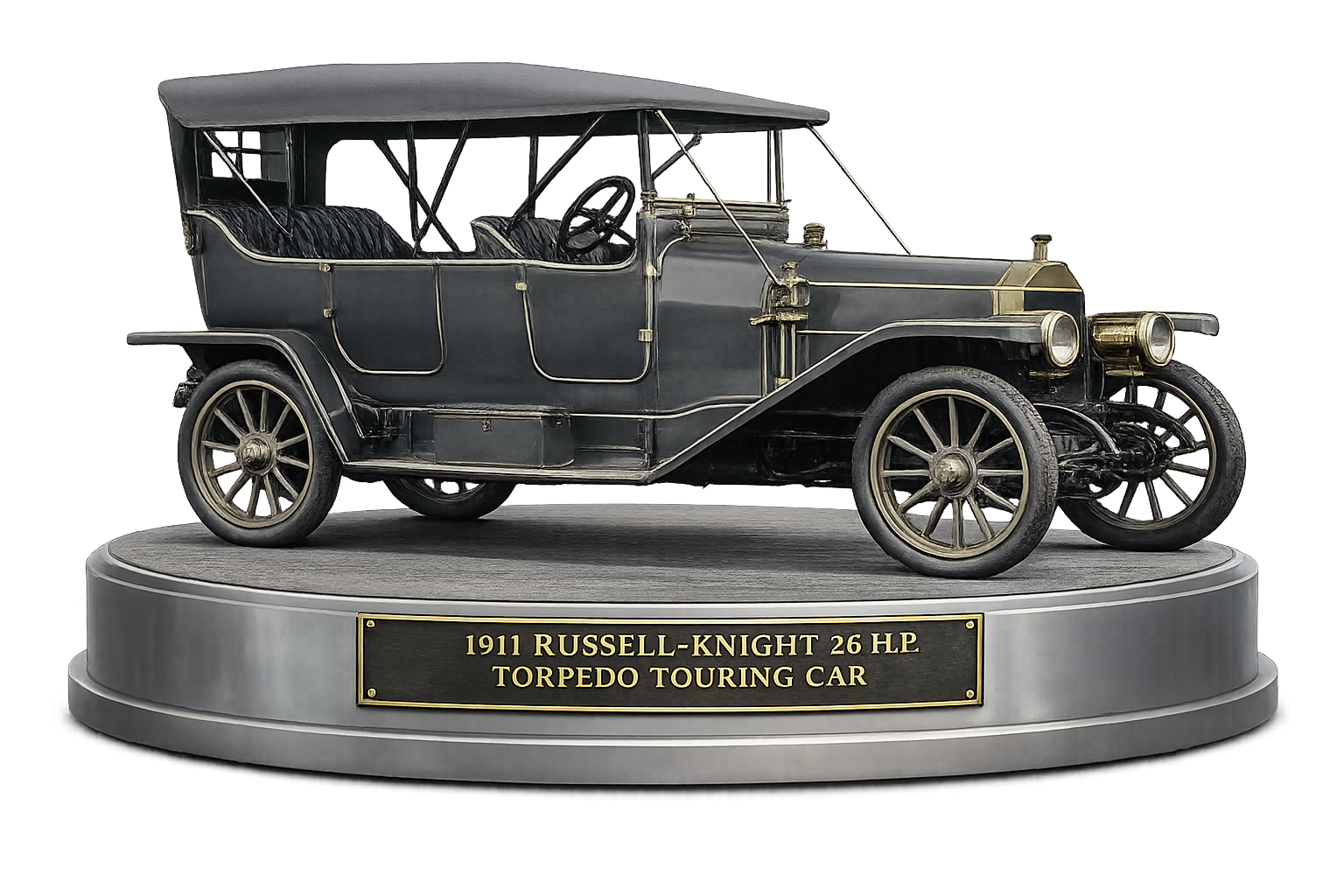
Before the Jeep, before the Model T became a punchline, before the words "automotive industry" meant anything to anybody in this country, there was a bicycle company in Toronto trying not to go broke. That company built the most important car Canada ever produced. Most Canadians have never heard of it. Most could not tell you the name if you spotted them the first four letters. That is worth sitting with for a minute.
Bicycles First, Cars Second
The Canada Cycle and Motor Company came together in 1899 the way a lot of big Canadian enterprises did: out of fear. Specifically, the fear that Americans were coming. The American Bicycle Company had just swallowed up forty-two manufacturers south of the border and was pointing north, hungry for more territory. So Walter Massey, son of Hart and grandson of Daniel, started buying. He pulled in Joseph Flavelle and George Cox, men who understood money the way a good mechanic understands torque, and together they bought out Canada's leading bicycle makers. H. A. Lozier. Massey-Harris's bicycle works. Goold of Brantford. Welland Vale Manufacturing out of St. Catharines. And Gendron Manufacturing of Toronto. Four companies, five, depending on which historian you are reading. The records are genuinely messy on this point. The new outfit controlled roughly eighty-five percent of Canadian bicycle production on the day it opened for business.
It nearly went under inside of two years.
The bicycle boom had already peaked. Adults who had money were buying automobiles now, or wanting to. The bicycle was becoming something for children, for newspaper boys, for men who could not afford anything better. CCM's five factories were each building different models with different parts and different inventory, and nobody at the top of the company actually rode a bicycle, which tells you something about how detached the whole operation had become from the thing it was supposed to be selling. A 1901 fire at the St. Catharines plant made everything worse. Investors started calling the directors "The Big Syndicate," and not affectionately.
Tommy Russell Arrives
The solution arrived in the form of a twenty-five-year-old farm boy from Usborne Township, out in South Huron County, who had a political science degree from the University of Toronto and no business experience whatsoever. His name was Thomas Alexander Russell. Everybody called him Tommy.
He had been running the Canadian Manufacturers' Association as its executive secretary, which sounds like the kind of job that polishes a man into smoothness, but Russell remained stubbornly unpolished. He had grown up helping his father breed Shorthorn cattle and show them at agricultural fairs. He knew machinery. He knew how to fix things when they broke. When CCM came calling around 1902, he took the job of general manager of a company that was bleeding money and did not seem to know why.
Within a year he had shut down the factories in St. Catharines, Brantford, Hamilton, and the redundant Toronto locations. Everything moved to the old H. A. Lozier plant at 408 Weston Road, in the area then known as Toronto Junction. One plant. One workforce. One coherent operation. That is the kind of thing that sounds obvious in hindsight and is excruciating to actually do.
Then he turned his attention to automobiles.
The Russell Takes Shape
In 1903, CCM acquired the assets of Canadian Motor Company Limited, a Toronto automobile outfit that had already failed. This was not, on the surface, an encouraging sign. Buying a dead car company is not typically step one in a recovery plan. But Russell saw the potential, and for the next two years the automobile division produced a small electric runabout called the Ivanhoe. Two passengers. A narrow body. Quiet enough that horses did not bolt at it, which counted for something in 1903.
The Ivanhoe was always a stepping stone. Russell's interest was in gasoline engines, in what they could do, in where they were going. And in 1905, the Russell Model A came out of the Weston Road plant and into the world.
Two cylinders, horizontally opposed, water-cooled, mounted up front. Twelve horsepower. Three-speed sliding-gear transmission with a column shift. You moved it from the column, not from a floor-mounted stick, which was not universal at the time. The wheelbase was ninety inches. The frame was laminated ash reinforced with steel, which was how you built things before pressed steel became the obvious answer. It came as a runabout or a touring car. The price was fifteen hundred dollars.
To put that in perspective: a Ford Model C cost roughly eleven hundred dollars in Canada at the same moment. The Russell cost four hundred more, and there were people willing to pay it.
Production in that first year was fewer than fifty cars. But the people who bought them talked about them, and talking matters in a market this small.
The slogan was "Made up to a standard - not down to a price," which is either a confident declaration of quality or an elegant way of explaining why your product costs more than the competition. In this case it was both.
In 1906 came the Model B, a larger two-cylinder car, and the Model C, Russell's first four-cylinder. In 1907 a forty-horsepower touring model arrived, followed in 1908 by a fifty-horsepower flagship. The cars were getting bigger, more capable, more expensive, and better. Body styles multiplied: runabout, touring in four- and seven-passenger forms, roadster, toy tonneau, torpedo, phaeton, cabriolet, landaulet, limousine, berline limousine. Russell built the bodies in-house. Built the engines in-house, too, which put it in a category almost by itself among Canadian manufacturers of the era.
January 1907 produced one of the better publicity stunts in the history of Canadian motoring. Somebody, Russell probably, decided to race a car against ice-yachts on the frozen surface of Lake Ontario. The Russell weighed half a ton. It was carrying four men. The ice-yacht on the other side of the line weighed a quarter of that, had two passengers, and was powered by wind filling a thirty-foot mast. By any reasonable analysis, the car should have lost badly. It did not. The Russell won. The crowd that had gathered on the ice to watch apparently cheered.
Sales offices opened in England. Then Australia. Then New Zealand. "The Thoroughly Canadian Car - built with Canadian material, Canadian labour, and Canadian capital" was how the advertisements framed it, which was marketing but also, in a way that most marketing is not, entirely true.
The Knight Bet
The bigger change came in 1909, when Russell negotiated a licensing agreement with the Daimler Motor Company of England. What he bought was the Canadian rights to Charles Yale Knight's sleeve-valve engine.
The Knight engine worked differently than a conventional poppet-valve design. Instead of mushroom-shaped valves that popped open and shut thousands of times a minute, the Knight used sliding steel sleeves inside the cylinder to control the intake and exhaust. The result was an engine that ran quieter, almost eerily quiet compared to what most people were used to. Daimler had staked a good part of its reputation on Knight engines by this point. So had other European makers. Russell thought it was the future.
For the first two years of the arrangement, complete Knight engines came from Daimler's factory in England and went directly into Russells. The 1910 models, the Knight 22 and the Knight 38, named for their horsepower ratings under the Royal Automobile Club's formula, were different machines from anything that had come before. The 22 started at thirty-five hundred dollars. The 38 at five thousand, climbing to sixty-five hundred for a limousine or landaulet. By 1913, the most expensive Russell-Knight cost approximately ten times what a Ford Model T cost in the same market.
In April 1911, the automobile operation was formally incorporated as a separate entity, the Russell Motor Car Company Limited, distinct from CCM. The cars had grown bigger than the bicycles.
Around 1912, Russell took over production of the Knight engine in Toronto. This was the decision that, in retrospect, carries the most weight.
The Failure Point
The sleeve valves started failing in 1913.
Not immediately, not dramatically, not in a way you could blame on one bad batch. The problem was lubrication. The sliding steel sleeves needed oil, constant oil, in exactly the right places, and the in-house production of the engine had introduced tolerances that did not quite match what Daimler had been doing. The sleeves scored. Engines seized. Cars that had been sold on reliability, staked on it, built a reputation upon it, were now unreliable.
Word travels fast in a small market.
Russell's response was methodical, and in its way impressive. A professor from the University of Toronto was brought in to run a three-hundred-hour endurance test on the revised engine. When that engine passed, the company announced a twenty-thousand-dollar challenge to any competing automaker that could match the result under the same conditions. Nobody took them up on it. Whether that was because no one wanted the fight or because the challenge was simply too steep to be worth the effort is a question history has not answered.
The car that came out of this period was the Model 28. Russell called it "the model designed for the future," and in 1913 that was not empty language. Silent chain-drive for the engine's mechanicals instead of conventional gearing. Force-feed lubrication. An electric starter motor, which meant you did not have to hand-crank the thing and risk a broken wrist if the engine kicked back. Full electric lighting, including a lighted speedometer. At night you could see how fast you were going. That sounds unremarkable now. At the time it was not.
But the damage to the brand had been done. Markets have memory, particularly at the luxury end, where buyers have options and are paying enough to feel entitled to hold grudges.
War Changes Everything
Then the war came.
On the fourteenth of August, 1914, Tommy Russell was on a train to Ottawa. He returned with an order from the Department of Militia and Defence, signed off by minister Sir Sam Hughes, for seven touring cars. Seven. A small beginning to what became something else entirely.
Hughes appointed Russell as an extra-departmental purchasing agent for the Canadian Expeditionary Force. Russell bought a hundred and forty-one chassis. His engineers designed bodies for them. By the thirteenth of September, the cargo was loaded onto eight steamers at Montreal. Russell crossed the Atlantic and oversaw the assembly himself, on Salisbury Plain, in the English autumn.
A parliamentary inquiry in 1915 looked at the contracts that had flowed to RMCC. Russell testified. The company had taken a six-percent profit on the work. He had taken no personal commission. No other Canadian manufacturer could have done what RMCC had done in the time that had been available. The Public Accounts Committee accepted this, because it was true.
On the nineteenth of July, 1915, the British War Office signed a contract with the Russell Motor Car Company for five hundred thousand fuses. This made RMCC the first Canadian business to receive a direct munitions contract from the British War Office, a distinction that sounds dry until you understand what it meant for the trajectory of Canadian industrial capacity during the war. By 1917, the company was running four factories. The workforce had grown to nearly six thousand people. More than three thousand of them were women, working day and night shifts that the painter George Agnew Reid documented in a canvas called Women Operators, WWI at Russell factory. The bicycles were long gone by then. So, effectively, were the cars.
The last Russell automobiles came off the line in 1915. The company sold its automotive assets to Willys-Overland, John North Willys's Toledo, Ohio, operation, with the deal announced publicly in November of 1915 and the formal acquisition completing in 1916. Willys wanted the Toronto plant. He also wanted, almost certainly, what Russell had built around the Knight sleeve-valve engine in Canada: rights, tooling, and knowledge that fit neatly with what Willys was doing in the United States under the Willys-Knight nameplate.
The Willys-Overland operation ran in the old Russell plant on Weston Road until 1933, producing the Whippet among other models, and, because Russell had spent years building dealer networks in the southern hemisphere, continued supplying right-hand-drive cars to Australia and New Zealand. The markets Russell had cultivated from Toronto, Willys harvested from the same address.
What Survives
Tommy Russell stayed with the parent company through the war and after. The Russell Gear and Machine Company rose from what the automobile operation left behind. He became president of Massey-Harris in 1930, during the worst years of the Depression, and by every account held that company together through sheer institutional will. In February 1938 the old company renamed itself Russell Industries Limited, which is how you acknowledge that something is finished without quite saying so. He was still at his desk, converting factories for a second war effort, when he fell ill in late December 1940. He died at home on the twenty-ninth of that month, sixty-three years old.
There are roughly thirty-two Russell automobiles still known to exist. Museums in Manitoba, Alberta, Saskatchewan, and Ottawa hold examples. There are active cars in British Columbia and Ontario. Australia and New Zealand each have survivors. The Canada Science and Technology Museum in Ottawa keeps a 1914 Russell-Knight Model 28 touring car, artifact number 1996.0569, donated by Thomas Russell's daughter, and has lent it out for exhibitions.
You can look at that car and understand something about what Canada was trying to be in the years before the First World War. An industrial nation. A country that built things with its own hands, from its own materials, with its own capital. The slogan said "Made up to a standard - not down to a price," and for a while that was not just advertising. It was an argument. An argument that a farm boy from South Huron County spent his career making, one model year at a time, in a factory on Weston Road that sold bicycles first and almost never sold cars at all.
The argument did not win. It rarely does, against scale and geography and American money. But it was made, and made well, and that is not nothing.